Are Prebuilt Dioramas Worth the Price? 2026 Collector's Guide
Table of Contents
- What Actually Drives the Price of a Prebuilt Diorama
- Prebuilt vs. DIY Diorama Cost: A Realistic Comparison
- How Prebuilt Dioramas Hold Their Value in the Resale Market
- Best Display Cases for 1:18 Cars: Protecting Your Investment
- How to Maintain Model Dioramas So They Last Decades
- Choosing the Right Prebuilt Diorama for Your Collection
- Frequently Asked Questions
Last Updated: September 18, 2026
What Actually Drives the Price of a Prebuilt Diorama
A prebuilt diorama is a finished miniature scene, assembled and painted by a maker, that arrives ready to display diecast models. The price reflects three things: materials, labor, and artistic detail. Understanding those inputs is the fastest way to judge whether a specific piece is priced fairly.
Material costs: scenic materials, paint, and structural components
Material costs in a diorama are modest relative to the finished price. Scenic materials, paint, printed wall graphics, and structural components typically account for a minority of the total. The rest is time.
Labor and assembly time: why handcrafted work costs more
Handcrafted work costs more because it is labor-intensive. Assembly time on a detailed 1:18 diorama runs into hours: fitting the display base, applying paint, wiring ceiling lights, and checking scale accuracy against the models it will hold.
Prebuilt vs. DIY Diorama Cost: A Realistic Comparison
DIY diorama vs prebuilt cost is not a simple dollar comparison. A kit has a lower sticker price, but you supply the tools, the paint, the scenic materials, and the hours. Prebuilt pricing bundles all of that into one number.
Here's how the two paths compare in practice:
| Factor | DIY Kit | Prebuilt Diorama |
|---|---|---|
| Upfront cost | Lower | Higher |
| Tools and paint | You buy | Included |
| Assembly time | Many hours | Minutes to an hour |
| Finish quality | Depends on skill | Consistent |
| Resale appeal | Variable | Stronger |
| Risk of mistakes | High | None |
How Prebuilt Dioramas Hold Their Value in the Resale Market
Resale value depends on maker reputation, condition, and whether the piece was a limited run. A well-kept diorama from a known maker holds value better than an anonymous one. But unlike diecast cars, there is no published price guide for miniature scenes, no Blue Book, no Beckett equivalent. That absence is exactly why most buyers guess wrong about what a used diorama is worth.
A working grading rubric for used dioramas
Since no industry standard exists, use this five-point rubric to score any used piece before you make an offer. Score each category 1-5 and total out of 25.
| Category | What to inspect | Why it moves price |
|---|---|---|
| Structural integrity | Base flat, no warped walls, no cracked acrylic | Repairs are hard to hide and kill resale |
| Finish condition | Paint fading, chipped edges, lifted decals | Fading is usually UV damage and is irreversible |
| Lighting function | LED strip, USB plug, on/off switch all working | A dead strip is the single most common defect |
| Completeness | Signage, parts counter, instructions, original box | Missing accessories drop the piece a full grade |
| Provenance | Maker mark, receipt, limited-run number | Verifiable origin sells faster and higher |
How depreciation actually works on dioramas
Three things protect resale value:
- Maker identity. A piece with verifiable origin sells faster than an unknown build.
- Original packaging and parts. Keep the parts counter, signage, and instructions.
- Lighting in working order. A dead LED strip is the most common defect on used dioramas.
Treat a well-made diorama as an investment piece only if you'd be happy keeping it regardless of what it resells for. The honest framing: a prebuilt diorama is a display purchase first and a store of value a distant second. If resale matters to you, buy limited runs from named makers, keep the box, and never store the piece in direct sun.
Best Display Cases for 1:18 Cars: Protecting Your Investment
The best display case for a 1:18 car is one that seals against dust, blocks UV light, and leaves enough clearance for the model plus its diorama base. Dust and sunlight do more damage than handling. But the case is also a line item in the true cost of owning a diorama, and most buyers never add it up.
The long-term cost of ownership
- Display case. A sealed UV-filtered acrylic case sized for a 1:18 diorama typically runs from about $40 to $150 depending on dimensions and whether it is gasketed. This is the single biggest add-on.
- UV protection. If you skip a UV-filtered case, expect paint and printed signage to fade within a few years in a sunlit room. Replacing faded printed graphics is often impractical, so the case is cheaper than the repair.
- Dusting supplies. A soft dry brush and a can of compressed air cost under $20 and last years. This is the cheapest line item and the one that prevents the most damage.
- Replacement adapter. USB-to-outlet adapters run about $5 and are the most common failure point. Keep one spare.
- LED strip replacement. If a strip dies, replacement is usually a maker-service item rather than a DIY fix, because the wiring is often routed through the base.
- Repairs. Loose signage, a cracked acrylic panel, or a detached part are the typical repair calls. Cost depends on the maker, but the pattern is that repairs are cheaper than replacement only if the piece is still in production.
What to look for:
Mr Norms Grand Spaulding Dodge Showroom →
- UV-filtered acrylic or glass. Sunlight fades paint over time.
- A sealed or gasketed frame. Fewer gaps means less dusting.
- Interior clearance. Measure the diorama footprint plus the tallest roof sign.
- Stable, level footing. A wobbling case is a tipped model waiting to happen.
The takeaway on cost of ownership: budget roughly 20-40% of the diorama's purchase price for a proper case and first-year supplies. A $249.95 licensed 1:18 showroom realistically costs closer to $300-$350 to own correctly in year one.
How to Maintain Model Dioramas So They Last Decades
Maintenance is simple and mostly about dust, light, and handling. A few habits keep a diorama looking new for years.
Handling rules matter more than cleaning:
- Lift by the base, never by the building.
- Keep the slide-out front panel closed when moving the piece.
- Store spare parts and signage in a labeled bag.
- Keep the display out of direct sun and away from heating vents.
Choosing the Right Prebuilt Diorama for Your Collection
Match the diorama to your models, your space, and your budget. Scale comes first. A 1:18 diorama needs a 1:18 car; a 1:64 scene suits smaller models.
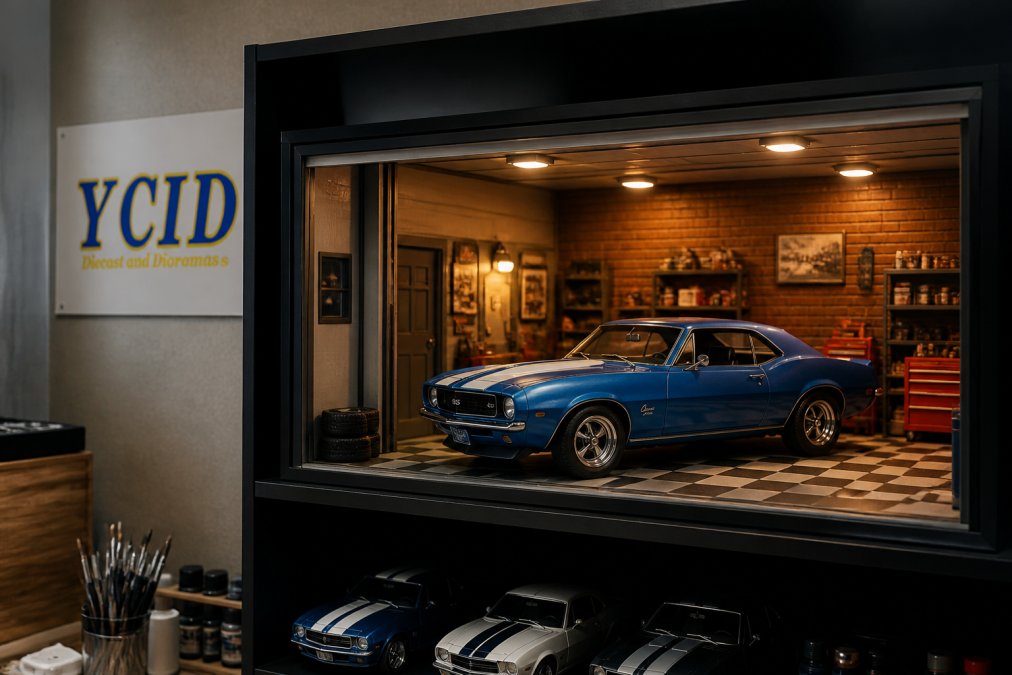
Here's how our current builds fit different collectors:
| Diorama | Scale | Price | Best For |
|---|---|---|---|
| Mr Norms Grand Spaulding Dodge Showroom | 1:18 | $249.95 | Muscle car collectors wanting a licensed landmark |
| Yenko Chevrolet Dealership | 1:18 | $239.95 | Displaying three cars in a real dealership layout |
| 1:18 Crankys Speed Shop | 1:18 | $114.95 | A larger scene with a four-stall parking lot |
| 1/24 Crankys Speed Shop | 1:24 | $59.95 | Mid-scale collectors with limited shelf space |
| 1/64 Crankys Speed Shop | 1:64 | $22.95 | Plug-and-play display on a tight budget |
Frequently Asked Questions
What factors determine the price of a professional diorama?
Four factors drive the cost: material quality, labor hours, scale, and artistic detail. A 1:18 scale showroom like the Mr. Norms Grand Spaulding Dodge replica at $249.95 uses licensed signage, working ceiling lights, and a slide-out front panel. Smaller scales cost less because they use fewer materials and less assembly time. The 1:64 version of the same diorama runs $39.95. Handcrafted weathering techniques, structural integrity, and scale accuracy all add to the final price.

Are prebuilt dioramas more cost-effective than DIY kits?
It depends on your time and skill level. A DIY diorama requires scenic materials, paint, tools, and dozens of hours of labor. If you value your time at even $20 per hour, a 40-hour build costs $800 in labor alone before materials. Prebuilt dioramas from YCID start at $22.95 for the 1/64 Crankys Speed Shop and $114.95 for the 1/18 version. For collectors who want a finished display base without the learning curve, prebuilt wins on total cost.
Do prebuilt dioramas increase the resale value of model cars?
A diorama itself rarely increases a car's resale value, but it can make a collection more attractive to buyers. When you sell a diecast model displayed in a themed environment with a display case, the presentation creates visual storytelling that justifies a higher asking price. The diorama's own resale market is smaller than the car market, so treat the diorama as a display investment rather than a financial one.
What materials are used in high-end 1:18 scale dioramas?
High-end dioramas typically use PVC, acrylic, and printed components for structural integrity and scale accuracy. The 1/64 Crankys Speed Shop, for example, is a PVC and acrylic factory-made product with clear side and front pieces, a printed rear wall, and an LED light strip. Larger scales may include slide-out panels, removable roof sections, and detailed interior elements like parts counters. These materials resist warping and hold paint application well over time.
How do I choose between a display case and a diorama?
A display case protects a single model from dust and handling. A diorama does that plus places the car in a scene that tells a story. If you own one or two prized cars, a case works fine. If you have a collection of American muscle cars and want a showroom or speed shop setting, a diorama adds context and visual impact. Many collectors use both: a diorama for the centerpiece car and cases for the rest.