Best 1/18 Scale Car Models for Collectors in 2026
Table of Contents
- What Makes a 1/18 Scale Model Worth Collecting
-
The Best 1/18 Scale Car Models Available Now
- 1. YCID #46, 1970 Plymouth Cuda, B3 Blue 440 Six Pack ($144.95-$194.95)
- 2. YCID #44, 1970 Dodge Challenger R/T 383 Shaker ($144.95-$195.95)
- 3. YCID #45, 1970 Dodge Challenger R/T Vanishing Point Tribute ($144.95)
- 4. YCID #42, 1972 Cuda 340, First 72 Cuda in 1/18 Scale ($144.95-$194.95)
- 5. YCID #41, 1969 Mustang Mach 1, Madagascar Orange ($144.95)
- 6. YCID #34, 1968 Dodge Dart GSS, Jay Leno Edition ($139.95-$199.95)
- 7. YCID #49, 1969 ZL1 Camaro, Hugger Orange (Pre-Order $5.00, Retail $144.95)
- 8. Crankys Speed Shop #1, 1970 Chevelle Moody Blues ($10.00, 18 Made)
- How to Display 1/18 Scale Model Cars
- Best Practices for Cleaning Diecast Models
- Can You Use Compressed Air on Diecast Models
- Verifying Authenticity and Protecting Collector Value
- Frequently Asked Questions
Last Updated: August 30, 2026
Few hobbies reward patience and knowledge the way diecast collecting does. The 1/18 scale models market has expanded dramatically, yet finding truly collector-grade replicas of American muscle cars remains difficult. At YCID Diecast and Dioramas, we specialize in exactly that gap: limited-run, precision-crafted 1/18 scale models built for collectors who know the difference between marketing claims and genuine craftsmanship.
This guide covers what separates investment-grade pieces from shelf-fillers, which construction materials matter and why, and the eight best 1/18 scale car models available now. We also address maintenance and display questions most guides ignore.
Quick Picks:
- Best Overall: YCID #46, 1970 Plymouth Cuda, B3 Blue 440 Six Pack
- Best Documented Provenance: YCID #34, 1968 Dodge Dart GSS, Jay Leno Edition
- Best Pre-Order Value: YCID #49, 1969 ZL1 Camaro, Hugger Orange ($5.00 deposit)
- Most Historically Significant: YCID #42, 1972 Cuda 340, First 72 Cuda in 1/18 Scale
What Makes a 1/18 Scale Model Worth Collecting
A 1/18 scale model is worth collecting when it combines scale fidelity to the source vehicle, production scarcity that protects long-term value, and construction quality that holds up over decades. Production runs capped at 199 units are meaningfully scarce; runs of 48 convertibles are rarer still. What elevates a model is limited edition production numbers combined with model-specific tooling that ensures interior accuracy and engine bay details are replicated rather than approximated.

Diecast vs. Resin: Which Construction Is Right for You
Diecast models are cast from zinc alloy with real opening parts, working suspension, articulated steering, and photo-etched details. They have weight and solidity, making them the standard for display-grade collector models.
Resin models are cast from polyurethane, allowing finer surface detail and complex shapes that metal tooling cannot achieve. The trade-off is fragility: resin does not tolerate drops or rough handling, and paint can crack under physical stress.
For most collectors focused on American muscle cars, diecast is the practical choice. Opening parts and chassis detail are part of the experience, and durability means the model survives handling at shows and photography sessions.
Scale Accuracy, Detailing, and Opening Parts
Scale accuracy in 1/18 models means every dimension is divided by 18 from the real vehicle. The best models specify the exact engine variant (a 440 Six Pack is distinct from a 440 Magnum), correct transmission (4-speed vs. automatic), and period-correct options like houndstooth interiors or vinyl tops. These specifics separate a replica from a genuine scale model.
The Best 1/18 Scale Car Models Available Now
The eight models below represent the strongest current offerings for serious collectors. Each is a limited-run, diecast piece with documented production numbers and a Certificate of Authenticity.
Model |
Production Limit |
Starting Price |
Key Distinction |
|---|---|---|---|
YCID #46, 1970 Cuda B3 Blue 440 Six Pack |
199 coupe / 60 convertible |
$144.95 |
Never made in 1/18 before |
YCID #44, 1970 Challenger R/T 383 Shaker |
199 coupe / 48 convertible |
$144.95 |
In stock, ready to ship |
YCID #45, 1970 Challenger R/T Vanishing Point |
199 |
$144.95 |
Most accurate VP tribute yet |
YCID #42, 1972 Cuda 340 |
199 coupe / 48 convertible |
$144.95 |
First 1972 Cuda in 1/18 scale |
YCID #41, 1969 Mustang Mach 1 Madagascar Orange |
199 |
$144.95 |
First Mach 1 in this color |
YCID #34, 1968 Dodge Dart GSS Jay Leno Edition |
199 coupe / 48 convertible |
$139.95 |
TV-documented provenance |
YCID #49, 1969 ZL1 Camaro Hugger Orange |
199 (pre-order) |
$5.00 deposit |
Never made with this tooling |
Crankys Speed Shop #1, 1970 Chevelle Moody Blues |
18 total |
$10.00 |
Rarest piece in this list |
1. YCID #46, 1970 Plymouth Cuda, B3 Blue 440 Six Pack ($144.95-$194.95)
This is the best overall pick for collectors who want something genuinely never made before in 1/18 scale. The 1970 440/6 Pack Cuda in B3 Blue with black interior and stripe has never been produced at this scale. Three versions are available: the standard coupe (limited to 199, $144.95), a black vinyl top version (limited to 96, $154.95), and a convertible with black boot (limited to 60, $194.95). The convertible at 60 units is among the most genuinely scarce pieces in the current market. Each comes with a numbered Certificate of Authenticity.

Best for: Collectors who want a historically significant first that fills an actual void in the 1/18 scale catalog.
2. YCID #44, 1970 Dodge Challenger R/T 383 Shaker ($144.95-$195.95)
The practical advantage of this model is simple: it is in stock and ready to ship. The model comes in black finish with white interior and side stripes. The 383 4-speed configuration is correct, and Magnum 500 road wheels are accurate to the period. Three versions: coupe (1-199, $144.95), vinyl top (1-72, $154.95), and convertible (1-48, $195.95).
Best for: Collectors who want immediate delivery without pre-order waiting periods.
3. YCID #45, 1970 Dodge Challenger R/T Vanishing Point Tribute ($144.95)
The Vanishing Point Challenger is one of the most recognizable muscle cars in automotive history. YCID #45 is the most accurate version yet produced, featuring the 440 Magnum engine, 4-speed transmission, houndstooth interior, flat stock fuel cap, single chrome driver's side mirror, and optional front bumper guards. Limited to 199 with COA included.
Best for: Film and automotive history enthusiasts who want the most faithful tribute to the original car.
4. YCID #42, 1972 Cuda 340, First 72 Cuda in 1/18 Scale ($144.95-$194.95)
YCID #42 holds a clear record: these are the first stock production 1972 Cudas ever made in 1/18 scale. The Lemon Twist Yellow finish with black stripes and interior is visually striking. The 340 4-speed specification is accurate. Versions include the coupe (1-199, $144.95), vinyl top (sold out), and convertible (1-48, $194.95).
Best for: Collectors building a complete Cuda lineage who need the 1972 year represented accurately.
5. YCID #41, 1969 Mustang Mach 1, Madagascar Orange ($144.95)
This is the first 1969 Mach 1 in special order Madagascar Orange in 1/18 scale. The Madagascar Orange color was applied to fewer than 300 real cars in 1969, giving this model genuine rarity on both the diecast and automotive history fronts. The 428 CJ engine specification is correct for a performance Mach 1. Limited to 199.
Best for: Ford and Mustang collectors who want a historically rare color variant documented in 1/18 scale.
6. YCID #34, 1968 Dodge Dart GSS, Jay Leno Edition ($139.95-$199.95)
Provenance is one of the most undervalued factors in diecast collecting. YCID #34 has documented provenance: the real 1968 Dart GSS it replicates was featured on Jay Leno's Garage and is currently in his collection. The model replicates the car accurately: 383 4-speed, Mopar Bronze Poly with black side stripe and interior, with BF Goodrich tires and Cragar mags matching the actual car. Three versions: coupe (1-199, $144.95), vinyl top (1-96, $154.95), and convertible with black boot (1-48, $199.95).
Best for: Collectors who prioritize documented real-world provenance alongside scale accuracy.
7. YCID #49, 1969 ZL1 Camaro, Hugger Orange (Pre-Order $5.00, Retail $144.95)
The ZL1 Camaro is one of the most significant performance cars of the muscle car era. According to Chevrolet's historical vehicle documentation, the ZL1 used an all-aluminum 427 block that was only ordered by a handful of buyers in 1969. YCID #49 replicates that specific car: aluminum block 427, 4-speed, body color dog dish wheels, in Hugger Orange. This model has never been made in 1/18 scale using the HWY61 tooling. Pre-order now for $5.00 deposit, with retail at $144.95 (minus deposit paid) due late summer. Limited to 199.
Best for: Camaro collectors and anyone who wants to lock in a historically significant first at minimal upfront cost.
8. Crankys Speed Shop #1, 1970 Chevelle Moody Blues ($10.00, 18 Made)
Eighteen units total production makes this the rarest piece in this entire list. This heavily modified 1970 Chevelle in Candy Blue features tunnel ram and dual quads, MSD box, resin cast headers, satin/flat black hood with hood pins, interior dash mount tach with shift light, trunk-mounted wired battery box and NOS bottle, Lakewood traction bars, Centerline wheels with slicks and skinnies, and period-correct decals.
Best for: Advanced collectors who want the most exclusive and extensively modified piece available.
How to Display 1/18 Scale Model Cars
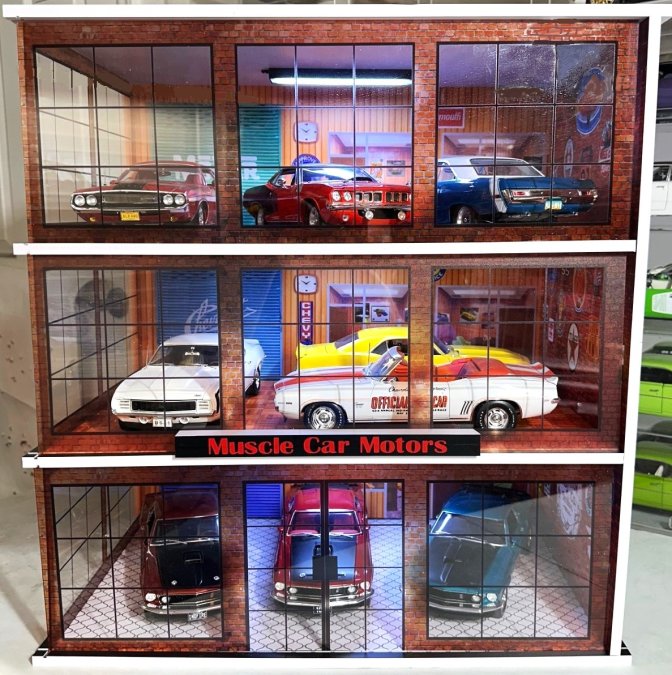
Proper display protects your investment and shows craftsmanship at its best. A 1/18 scale model needs a minimum shelf depth of 12 inches and clearance height of at least 6 inches. Purpose-built display cases with glass doors block dust accumulation and protect paint finish from UV exposure that causes fading.
Shelving, Display Cases, and Lighting Options
For lighting, LED strip lighting mounted at the front top edge of each shelf produces even illumination without the heat that incandescent bulbs create. Heat accelerates diecast rot, the oxidation process that causes zinc alloy to expand, crack, and crumble. Avoid placing display cases near exterior walls in climates with significant seasonal temperature swings. A relative humidity level between 45 and 55 percent is the target range for long-term preservation.
Best Practices for Cleaning Diecast Models
The correct method for routine cleaning is a soft natural-hair brush, the kind used for watercolor painting or camera lens cleaning. Brush dust from the surface using light, directional strokes. For stubborn dust in recesses, a cotton swab slightly dampened with distilled water works on most painted surfaces. Avoid tap water, which contains minerals that leave residue. Never use household cleaning products, alcohol-based solutions, or anything with solvents on a diecast model.
For chrome parts on wheels and trim, a dry microfiber cloth is sufficient. Chrome is more vulnerable to scratching than painted surfaces.
Cleaning Task |
Correct Tool |
What to Avoid |
|---|---|---|
Routine dust removal |
Soft natural-hair brush |
Compressed air |
Recessed areas |
Cotton swab, distilled water |
Tap water, solvents |
Chrome wheels and trim |
Dry microfiber cloth |
Abrasive cloths, polish |
Paint surface |
Dry microfiber or brush |
Household cleaners, alcohol |
Engine bay detail |
Fine brush, dry |
Water near photo-etched parts |
Can You Use Compressed Air on Diecast Models
Compressed air is not recommended for cleaning diecast models. The pressure can force dust and debris into gaps rather than removing it, and moisture content in compressed air can accelerate oxidation on zinc alloy surfaces. Canned air products often contain propellants that leave residue when tilted or held too close to a surface.
The more serious concern is diecast rot. Zinc alloy oxidizes when exposed to moisture and temperature fluctuations. Introducing compressed air directly into door gaps and engine bay openings creates the micro-environment that accelerates this process. For dust removal in tight areas, a fine natural-hair brush is slower but far safer.
Verifying Authenticity and Protecting Collector Value
The baseline standard for any serious 1/18 scale limited edition is a numbered Certificate of Authenticity that matches the model's serial number. Every YCID model includes a COA. The number should correspond to the production sequence, and the total production number should be verifiable against the manufacturer's stated run.
Authenticity verification involves examining physical markers. Paint finish on authentic limited editions shows consistent depth and clarity across body panels. Paint rash, misaligned panel gaps, inconsistent chrome quality, or decals showing bleeding at edges are signs of quality control failures. For secondary market purchases, original box condition matters. The Diecast Hall of Fame collector resources provides guidance on model grading standards that the broader hobbyist community uses to assess condition and value.
Collector value protection comes down to three practices: keep models in their original boxes when not displayed, maintain stable environmental conditions, and document your collection with photographs showing condition at acquisition.
Serious collectors know that the hardest part of this hobby is finding the right models at the right production numbers with documentation to back up claims. YCID Diecast and Dioramas addresses that directly through numbered COAs, genuinely limited production runs, and model-specific tooling that produces accurate replicas. Free US shipping applies on in-stock orders over $300. Browse the current catalog and secure the models that matter to your collection before production numbers close.
Frequently Asked Questions
What features define a high-quality 1/18 scale model?
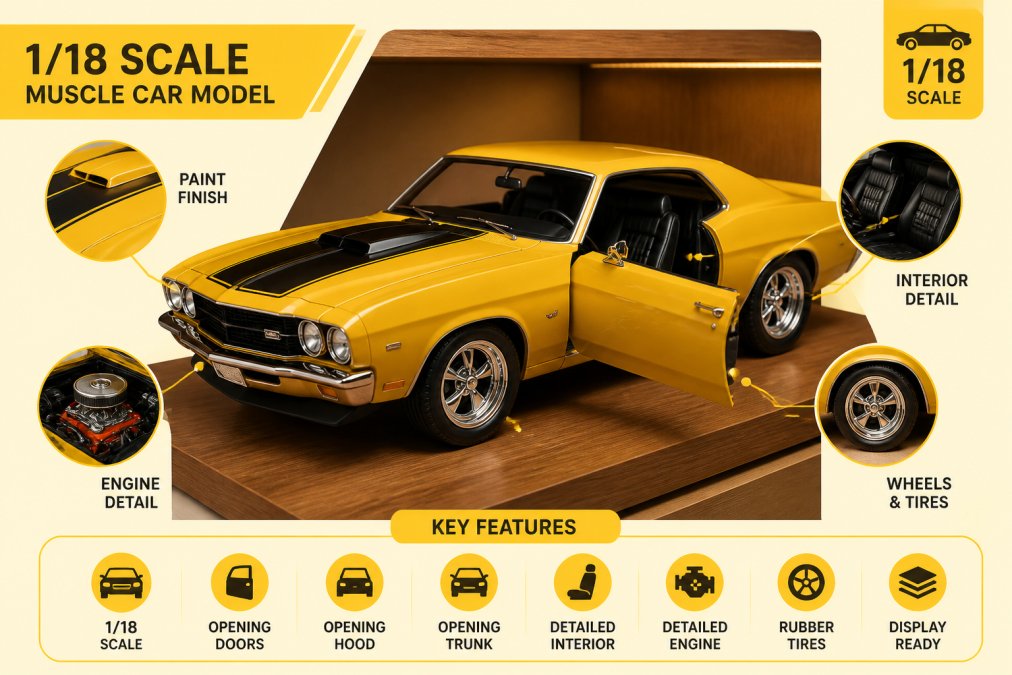
A high-quality 1/18 scale model should have accurate scale fidelity to the real vehicle, opening parts (doors, hood, trunk), a detailed engine bay, correct interior accuracy including gauges and upholstery, and a flawless paint finish. Photo-etched parts, articulated steering, and hand-assembled construction are additional markers of craftsmanship. A certificate of authenticity (COA) and a documented, limited production run add both credibility and long-term collector value.
Are resin or diecast 1/18 models better for collectors?
Diecast metal models offer heft, durability, and typically include opening parts that let you inspect interior accuracy and the engine bay. Resin models allow for finer surface detail and are often used for ultra-limited, hand-assembled replicas where precision detailing matters more than play features. For American muscle car collectors, diecast is generally preferred because the scale accuracy and opening parts make the replica feel closer to the real vehicle. High-end diecast 1/18 scale models from specialized producers sit firmly in investment-grade territory.
How do I determine the value of a 1/18 scale model car?
Value depends on production run size, manufacturer reputation, subject rarity, condition, and whether the model comes with its original box and COA. Models limited to under 200 units from specialty producers hold value better than mass-market releases. Condition grading is critical: paint rash, diecast rot, or missing parts significantly reduce collector value. Models replicating historically significant or low-production real vehicles, like a 1969 ZL1 Camaro or a 1970 Cuda 440 Six Pack, tend to command stronger secondary-market prices.
What are the best 1/18 scale car models for American muscle car enthusiasts?
American muscle car enthusiasts should look for 1/18 scale models that replicate documented, low-production real vehicles with correct engine, transmission, and trim details. YCID Diecast and Dioramas produces exactly this type of release, including never-before-made versions like the 1970 Cuda 440 Six Pack in B3 Blue (YCID #46, from $144.95), the 1972 Cuda 340 (YCID #42, from $144.95), and the 1969 Mustang Mach 1 in Madagascar Orange (YCID #41, $144.95), each limited to 199 or fewer units with a COA.
Is it worth investing in premium 1/18 scale diecast models?
Premium 1/18 scale diecast models with small production runs and documented COAs have historically held or grown in value within the collector community, particularly when the subject vehicle is rare or culturally significant. The key factors are production run size (under 100 is stronger than under 200), condition preservation, and original packaging. Models that are the first-ever 1/18 scale replica of a specific variant carry additional scarcity value. That said, buy what you genuinely want to display, not purely as a financial vehicle.