Buy Limited Edition Muscle Cars: Collector's Guide
Table of Contents
- Why Limited Edition Muscle Cars Hold Their Value
- Best Practices for Classic Car Investment
- How to Verify Muscle Car VIN Numbers
- Buying 1:18 Scale Muscle Cars Online
- Auction vs. Private Sale Strategy for Limited Edition Muscle Cars
- Maintenance Costs for Rare Variants
- Frequently Asked Questions
Last Updated: September 13, 2026
Why Limited Edition Muscle Cars Hold Their Value
Limited edition muscle cars hold their value because scarcity, documentation, and originality create a supply ceiling demand rarely breaches. Build only a few hundred examples of a high-performance variant and every survivor becomes a fixed asset.
This guide from YCID Diecast and Dioramas covers what drives that value, how to verify a car before you buy limited edition muscle cars, and where the real risks sit.
Production Numbers and Rarity
Rarity is the foundation of collector value, but production numbers only matter when verifiable. A run of 199 units carries different weight than one built in the thousands.
"Limited production" claims get inflated constantly: a dealer may call a car rare because of its color while the actual drivetrain figure is far higher. Serious collectors separate marketing rarity from documented rarity.
- Documented rarity: Factory records, broadcast sheets, or registry listings confirm the build count.
- Perceived rarity: A seller's claim with no paperwork behind it.
- Condition rarity: A common model that survives in unusually original condition.
Investment Potential of Collector Cars
Investment potential depends on four variables: rarity, originality, condition, and provenance. Miss one and the market discounts the car heavily.
Originality often outweighs cosmetic perfection. A car with its factory engine, transmission, and rear axle, even with faded paint, outperforms a beautifully restored car with a replacement drivetrain.
Documentation also pays: a vehicle history report, original window sticker, and ownership chain raise confidence, and confident buyers pay more.
Best Practices for Classic Car Investment
Best practices for classic car investment start with research before money changes hands. Buyers who lose money usually fell in love with a car before verifying it.
A disciplined approach looks like this:
- Confirm the VIN and trim tag decode to the claimed configuration
- Request a vehicle history report and review title transfers
- Have an independent inspector examine the car in person
- Verify the engine, transmission, and rear axle stampings
- Check the build documentation against the car's current parts
- Set a maximum price before negotiating, and walk away if it is exceeded
The inspection is the single step separating a sound purchase from an expensive lesson.
Provenance and Authentication Guide
Provenance is a vehicle's documented ownership and history chain, and the strongest value driver after originality. A clean, continuous paper trail commands a premium because buyers can trust what they are purchasing.
Authentication works backward from the paperwork: start with the VIN, match the trim tag, verify drivetrain stampings, then compare everything against factory records. When all four align, the car is what it claims to be.
National Highway Traffic Safety Administration VIN decoder guidance provides a starting point for understanding how vehicle identification numbers are structured, which helps you spot a re-stamped or altered tag before you commit.
How to Verify Muscle Car VIN Numbers
Verifying a muscle car VIN means decoding each character against factory records, then confirming the physical stampings match. The VIN encodes model year, assembly plant, and often engine and body style, but a correct decode proves nothing if the metal underneath has been altered.
To verify a VIN, follow this sequence:
- Locate the VIN plate on the dashboard and the stamped VIN on the body or frame.
- Decode the sequence using a factory or model-specific reference guide.
- Compare the decoded engine code against the engine actually installed.
- Check the trim tag for paint and interior codes.
- Cross-reference everything against the broadcast sheet or build record.
If the decoded engine code says small block and the car has a big block under the hood, the car is not original, regardless of what the listing claims.
Where the Numbers Actually Live
A single VIN is not enough. Limited-production cars carry multiple stampings, and serious verification checks all of them because a re-stamp usually shows up in the gaps between them.
- Dash VIN plate: The visible tag, held by rivets. Factory rivets have a specific rosette pattern; hardware-store rivets are a red flag.
- Door jamb or door-edge tag: Carries the trim, paint, and build date codes. Compare the build date against the engine and transmission casting dates.
- Engine pad or boss: Stamped with a partial VIN and an assembly date. The font, spacing, and depth should match known originals for that plant.
- Transmission case: Stamped with a partial VIN on most high-performance units.
- Rear axle tube: Stamped with a code that ties to the ratio and, on some makes, the partial VIN.
- Body or frame stamping: A hidden partial VIN on the firewall, cowl, or frame rail that thieves and re-body builders frequently overlook.
A common pattern is a car with a clean dash tag and a mismatched frame stamping. That combination almost always means the shell and the paperwork came from two different vehicles.
Reading Date Codes Against the Build
Date codes are the quiet authentication tool most buyers ignore. Casting dates on the block, heads, intake, and transmission should precede the car's assembly date by weeks rather than months, and never postdate it.
If the trim tag says March and the block was cast in August of the same year, the engine did not leave the factory in that car. This is one of the fastest ways to catch a restamped drivetrain, because forging a date code is harder than forging a partial VIN.
Re-Stamp and Re-Body Tells
Re-stamping means grinding a correct VIN or engine code into a replacement part; re-bodying means moving tags and paperwork onto a cleaner shell. Both are common enough on high-value limited editions that buyers should assume nothing.
- Broach marks: Factory engine pads have parallel machining marks. A decked pad is smooth or shows swirl marks.
- Font and spacing: Stamps were applied by specific tooling at each plant. Character height, spacing, and depth should be consistent across the pad.
- Rivet condition: Original dash rivets are undisturbed. Scratches around the tag suggest it has been removed.
- Weld and seam condition: A re-body often shows non-factory welds at the cowl, floor, or frame, or seam sealer that does not match the opposite side.
- Paint and primer overspray: A tag that has been off the car usually shows a clean outline or fresh paint underneath.
National Highway Traffic Safety Administration VIN decoder guidance provides a starting point for understanding how vehicle identification numbers are structured, which helps you spot a re-stamped or altered tag before you commit. For make-specific stamping locations and font references, factory service manuals and marque registry documentation are the practical references buyers rely on.
Matching Numbers and Chassis Codes
Matching numbers means the engine, transmission, and rear axle carry stampings corresponding to the VIN and to each other. Such a car is worth more because it retains its original drivetrain, the hardest part to replace correctly.
Chassis codes add another layer: they identify the body platform and are stamped or tagged in specific locations. A chassis code that does not match the model year or trim level signals a car pieced together from multiple vehicles.
For limited editions, the standard is higher than matching numbers alone: the car should also match its documented build configuration, correct carburetor, intake, exhaust manifolds, rear gear, and trim. A matching-numbers car missing its original high-performance-specific parts is still a discount car.
Buying 1:18 Scale Muscle Cars Online
Buying 1:18 scale muscle cars online rewards the same discipline as buying a full-size car: verify the seller, confirm the documentation, and understand what you are receiving. Scale models have their own version of matching numbers, the certificate of authenticity.
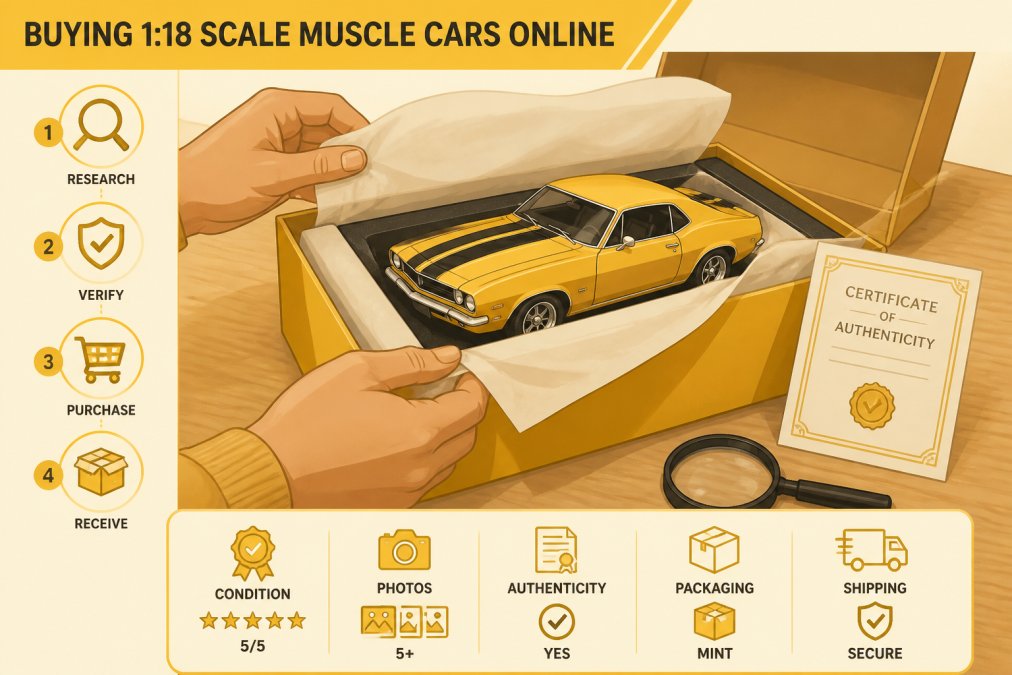
A limited-run model with a numbered COA holds more collector interest than an open-stock release, for the same reason a documented production car does. YCID Diecast and Dioramas builds its releases around that principle, producing 1:18 scale American muscle cars in defined runs with a certificate of authenticity.
Here is how the current YCID lineup compares for collectors weighing their next acquisition:
| Model | Limited Run | Price | Standout Detail |
|---|---|---|---|
| 1970 Hemi Cuda, Vitamin C Orange | 1-199 | $144.95 | Barn-find Hemi, 4-speed, shaker hood |
| 1972 Cuda 340, Lemon Twist Yellow (coupe) | 1-199 | $144.95 | First 1972 Cuda in 1:18 scale |
| 1971 Cuda 340, Bahama Yellow | 1-199 | $139.95 | First stock 340 Cuda from HWY61 tooling |
| 1971 Cuda 440/6, In Violet | 1-180 | $149.95 | Opening hood, doors, and trunk |
| 1970 Cuda 440/6, B3 Blue (coupe) | 1-199 | $144.95 | Never before made in 1:18 scale |
The 1970 Hemi Cuda in Vitamin C Orange stands out for collectors chasing historical weight, replicating a documented barn-find car shown at a national event. For a Mopar-focused shelf, the 1971 Cuda 440/6 in In Violet balances limited production and detail.

Auction vs. Private Sale Strategy for Limited Edition Muscle Cars
Auction versus private sale depends on how much time and risk you can absorb. Auctions create competition and can push a rare car above its expected range, but charge buyer and seller fees and move fast.
Private sales give you time to inspect, negotiate, and verify provenance without an auction clock, but pricing is less transparent, so you need your own valuation research.
| Factor | Auction | Private Sale |
|---|---|---|
| Price discovery | Competitive, can exceed estimates | Negotiated, often below retail |
| Inspection time | Limited, sometimes pre-sale only | Flexible, arrange your own |
| Fees | Buyer and seller premiums apply | Usually none |
| Provenance check | Documents available on request | Depends entirely on the seller |
| Best for | Rare, well-documented cars | Buyers who want time to verify |
For limited production cars with strong documentation, auctions tend to reward sellers. For cars with incomplete paperwork, a private sale gives the buyer room to investigate before committing.
Maintenance Costs for Rare Variants
Maintenance costs for rare variants run higher than for common models, and the gap is wider than most buyers expect. Parts for limited-production drivetrains are scarce and carry a premium when they surface, the part of the hobby most buying guides skip, and the part that determines whether a car stays on the road or becomes a static liability.
Routine upkeep is easy: oil changes, belts, hoses, and fluids are manageable from general suppliers. The real expense appears when something specific breaks, and on a limited-production car, something specific always breaks eventually.
Where the Money Actually Goes
Rare-car ownership splits into four cost buckets, and only the first is predictable.
- Consumables and routine service: Filters, fluids, belts, hoses, brake pads, and tires. Manageable, though correct-date-coded hoses and belts cost more than generic equivalents.
- Correct replacement parts: A date-coded alternator, a factory-correct carburetor, a correct radiator, or a specific intake manifold. These are the items that turn a weekend repair into a months-long search.
- Machine work and rebuilds: Limited-production engines often need specialized machining, and not every shop has the tooling or the reference data. Labor rates for a correct rebuild reflect that.
- Cosmetic and body parts: Limited-edition-specific grilles, spoilers, hoods, and trim pieces are the hardest category, because they were only made for one model year or one package.
A common pattern: a buyer budgets for the purchase and first service, then discovers a single correct component costs more than a year of routine maintenance on a common car.
Sourcing Channels and What They Cost You
Rare parts do not come from a catalog. They come from a small number of channels, each with its own trade-off.
- Marque-specific swap meets and club networks: Often the best source for correct parts, but availability depends on who shows up and what they brought.
- Specialist dismantlers: Reliable for used original parts, but you are buying condition as-is and paying for scarcity.
- Online collector forums and classifieds: Good for hard-to-find items, but you are competing with every other owner of the same limited run.
- Reproduction suppliers: Fills the gap for many cosmetic and mechanical parts, but reproductions are not original, and on a high-value car that distinction affects resale.
- Niche machine shops and fabricators: The last resort for parts nobody reproduces, and usually the most expensive per unit.
The practical consequence is time: a correct part may take weeks or months to surface while the car sits. That downtime costs even when no money changes hands, because a car that is not driven is not maintained, and seals, fluids, and fuel systems degrade.
Ongoing Ownership Costs Beyond Parts
Storage and insurance add ongoing cost: climate-controlled storage protects paint and interior, and agreed-value insurance costs more than standard coverage because payout is tied to market valuation rather than a depreciated book figure. Limited-production cars also tend to be driven less, which sounds like savings but often means more per-mile maintenance when used.
Fuel and drivability count too: high-compression engines built for leaded fuel often need octane boosters or additives, and carbureted cars require periodic tuning that fuel-injected cars do not.
The Resale Trade-Off
There is a counterintuitive upside: a limited-production car with a documented maintenance history, correct parts, and receipts commands a premium at resale, because the next buyer knows what they are inheriting. Owners who cut corners on correct parts save now and discount the car later.
That is the real maintenance calculus for rare variants: the cost is not just what you spend, but what the car is worth when you sell. Buyers who understand that treat maintenance as an investment in provenance, not an expense to minimize.
Frequently Asked Questions
What defines a limited edition muscle car?
A limited edition muscle car is a factory-built variant with a capped production run, often fewer than 500 units, featuring unique paint codes, engine options, or trim packages not available on standard models. Documentation like a certificate of authenticity, build sheet, or window sticker confirms the edition. For diecast collectors, brands like YCID Diecast and Dioramas release numbered runs such as the 1970 Hemi Cuda limited to 199 pieces, each with its own COA.
How do I verify the authenticity of a limited edition muscle car?
Start by checking the VIN against the original build sheet and window sticker to confirm the engine, transmission, and paint code match. Look for matching numbers on the engine block, transmission, and chassis stampings. For diecast models, verify the certificate of authenticity and the numbered production limit. YCID Diecast and Dioramas includes a numbered COA with every limited release, which makes authentication straightforward for collectors.
What are the best practices for classic car investment?
Focus on documented provenance, low production numbers, and original equipment. Cars with matching numbers and a verifiable ownership history hold value better than modified examples. Restomod builds can appreciate but only when the work is documented and reversible. For scale models, the same logic applies: limited runs with COAs and original packaging tend to retain value. Always factor in storage, insurance, and maintenance costs before buying.
Where can I buy 1:18 scale muscle cars online safely?
Buy from specialist retailers that provide detailed product photos, clear stock status, and a certificate of authenticity with each limited release. YCID Diecast and Dioramas offers 1:18 scale American muscle cars with numbered COAs and free US shipping on in-stock orders over $300. Check return policies and packaging standards before ordering, and confirm the model is in stock rather than a pre-order if you need it quickly.
How does rarity affect resale value for limited edition muscle cars?
Lower production numbers generally mean higher resale value, especially when the variant has a unique engine or color combination. A 1-of-199 diecast release like the YCID #43 1970 Hemi Cuda in Vitamin C Orange tends to appreciate faster than an open-run model. For full-scale cars, documented rarity plus matching numbers and original condition drives auction prices. Condition, provenance, and demand from collector car culture all influence final value.