1969 Camaro Diecast Model Collector Guide
Table of Contents
- Understanding 1969 Camaro Diecast Models
- 1969 Camaro Model Car Scales: Which One to Choose
- 1969 Camaro Diecast Replica Details to Evaluate
- Identifying Variants and Collector Editions
- Collectible Camaro Model Cars: Condition and Authentication
- 1969 Camaro Model Car Display and Storage
- Building and Valuing Your Collection
- Frequently Asked Questions
Last Updated: October 10, 2026
Understanding 1969 Camaro Diecast Models
The 1969 Camaro diecast model represents one of the most sought-after American muscle car replicas in the collector community. YCID's precision-crafted miniatures capture the era's performance DNA, from aggressive RS hidden headlights to iconic SS badging and Z/28 performance packages.

The variety of factory options, 350, 302, 427 engines, convertible and coupe bodies, and colors like Azure Turquoise, Le Mans Blue, Hugger Orange, and Burnished Brown, means collectors can pursue multiple variants without repetition.
1969 Camaro Model Car Scales: Which One to Choose
Selecting the right scale depends on your display space, budget, and collecting goals. The 1969 Camaro diecast model is available across three primary scales, each offering distinct advantages for different collector profiles.
1:18 Scale Models
The 1:18 scale represents the gold standard for serious muscle car collectors. At this scale, a 1969 Camaro replica measures approximately 10 inches in length, revealing intricate details that smaller scales simply cannot capture. YCID's 1:18 offerings, including the Azure Turquoise SS 350 and Le Mans Blue Z/28, showcase museum-quality construction with opening doors, functional hoods, and detailed engine bays.
The 1:18 scale reveals fine details: vinyl top texture, stripe precision, interior trim authenticity, and individually cast chrome plating and door handles. A standard 36-inch shelf accommodates 3-4 models comfortably. This scale suits collectors prioritizing quality over quantity and those with dedicated display furniture.
Collectors pursuing 1:18 typically build focused collections of 6-10 pieces representing key variants rather than attempting comprehensive coverage.
1:24 Scale Models
The 1:24 scale offers meaningful detail at approximately 7.5 inches in length. A single 48-inch shelf accommodates 6-8 models, making 1:24 ideal for collectors with moderate shelf space or limited display furniture.
At 1:24, exterior details remain sharp with legible stripe work and crisp body lines. Interior details are simplified compared to 1:18, but opening doors and hoods are typically functional.
This scale enables collectors to acquire 12-15 different variants across paint colors, engine options, and body styles without overwhelming display space.
1:64 Scale Models
The 1:64 scale represents the entry point for casual collectors and those focused on volume acquisition. At roughly 3 inches in length, a single 36-inch shelf accommodates 15-20 models, making 1:64 ideal for collectors with severe space constraints.
At 1:64, exterior paint and stripe work remain visible, but interior detail is minimal. These models excel in YCID's finished dioramas, which accommodate 1:64 scale models alongside 1:18 and 1:24 pieces for mixed-scale displays.
This scale suits collectors building thematic collections, those new to collecting, or enthusiasts using models in diorama displays.
Scale Comparison Framework
| Scale | Detail Level | Typical Collection Size | Best For |
|---|---|---|---|
| 1:18 | Museum-grade; opening doors, detailed engine bay, plated chrome | 6-10 pieces | Quality-focused collectors with dedicated display furniture |
| 1:24 | Good detail; functional doors, simplified engine bay | 12-15 pieces | Balanced collectors seeking variety without excessive footprint |
| 1:64 | Basic detail; painted features, no opening doors | 20+ pieces | Volume collectors, diorama integration, space-constrained displays |
1969 Camaro Diecast Replica Details to Evaluate
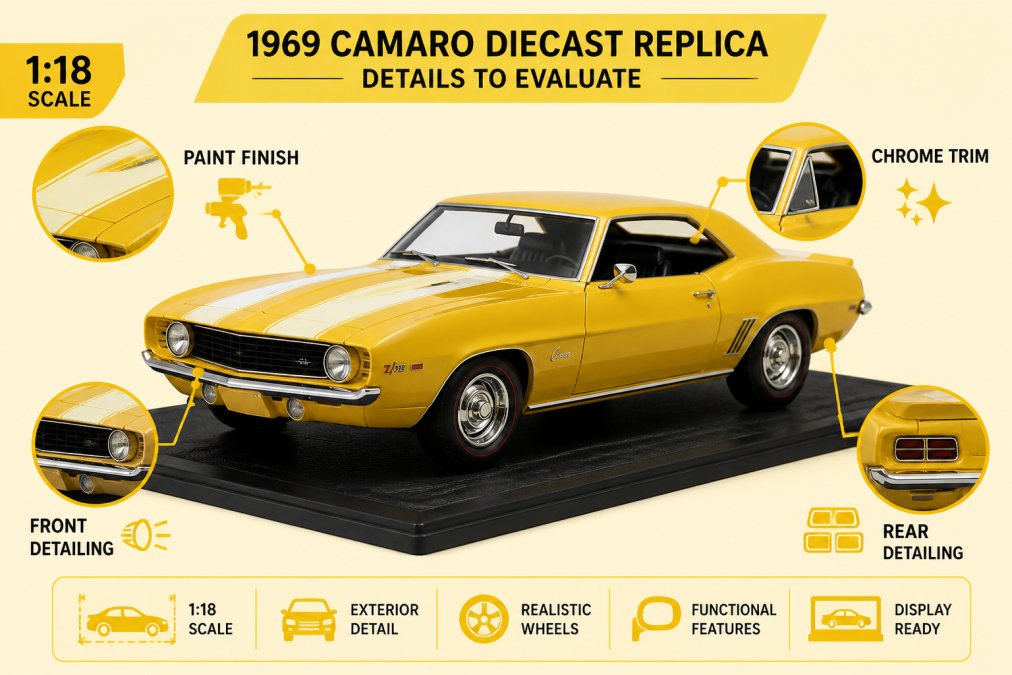
Evaluating a 1969 Camaro diecast model requires attention to specific quality markers that separate investment-grade replicas from mass-produced alternatives.
Exterior Styling and Paint Finish
YCID's 1969 Camaro diecast models feature multi-layer paint processes capturing original factory finishes. Azure Turquoise, Le Mans Blue, Hugger Orange, and Burnished Brown represent authentic 1969 color combinations.
Factory-correct stripes maintain consistent width, proper alignment, and sharp edges. Chrome trim, bumpers, and trim rings should display consistent plating without pitting or discoloration.
Interior Quality and Working Features
Opening doors reveal interior craftsmanship. The 1969 Camaro diecast model should feature detailed door panels, seat stitching, and dashboard. YCID models include detailed steering wheels and instrument clusters reflecting the specific engine option.
Functional hoods and trunks should open smoothly, with engine bays displaying appropriate detail for the 350, 302, or 427 engine variation.
Identifying Variants and Collector Editions
Production numbers significantly impact collectibility and long-term value. YCID's limited-run approach establishes clear scarcity parameters that serious collectors understand.
Variant identification requires attention to engine options, body styles, paint colors, and interior configurations. The Z/28 variant represents high-performance authenticity, while the COPO 427 offers documented provenance.

Production-numbered box stickers and certificates of authenticity accompany YCID releases, protecting your investment.
Collectible Camaro Model Cars: Condition and Authentication
Condition assessment and authentication are foundational to confident collecting. Understanding standardized condition tiers and verifying production provenance protects your investment.
Condition Grading Standards
The collector community employs a five-tier condition scale that applies consistently across diecast models:
Mint in Box (MIB): The model remains sealed in factory packaging with zero handling. The box shows no creasing, staining, or wear. MIB pieces command premium valuations.
Mint (M): The model has been removed from the box but displays no visible damage. Paint is flawless, chrome shows no pitting, and doors align perfectly. Mint models represent the practical target for serious collectors.
Near Mint (NM): The model displays minor imperfections visible only under magnification. Near Mint pieces retain strong collector appeal and value.
YCID #23, 1969 Camaro SS 350 →
Excellent (EX): The model shows obvious but not severe wear. Paint chips are visible without magnification. Chrome may display light pitting. Excellent condition models are suitable for display.
Good (G) and Fair (F): Models showing significant wear represent compromised investment potential.
Authentication Verification Checklist
Authentication begins with verification of production numbers, paint codes, and interior configurations:
Production Documentation: Examine the box for a production-numbered sticker. A missing or illegible production number warrants caution.
Certificate of Authenticity: YCID models include a certificate of authenticity (COA) documenting the variant, production number, and paint code.
Paint Code Verification: The underside displays a paint code corresponding to the specific color variant.
Interior Configuration Accuracy: Interior trim, seat color, and dashboard details must match the specific engine variant. Inconsistencies suggest either a reproduction or factory assembly error.
Casting Seams and Mold Marks: Examine the underside for consistent mold seams. Authentic YCID castings show clean, consistent seams. Rough or irregular surfaces warrant skepticism.
Wheel and Tire Quality: Authentic models feature precision-cast wheels with consistent spoke detail. Wheels should rotate freely without grinding or binding.
Chrome Plating Consistency: Authentic chrome displays uniform luster across all plated surfaces.
Red Flags for Reproductions and Damage
Certain indicators suggest a model is either a reproduction or has suffered damage that compromises authenticity:
- Blurry or misaligned stripe work: Factory-correct stripes maintain sharp edges and consistent width. Blurred, wavering, or misaligned stripes indicate either a poor-quality reproduction or damage from improper storage or handling.
- Inconsistent paint finish: Authentic models display uniform paint depth and luster. Dull spots, orange-peel texture, or glossy patches suggest either a reproduction or UV damage from improper display.
- Loose or rattling interior components: Opening the doors should reveal a solid interior with no loose parts. Rattling or shifting interior details indicate either a reproduction with poor assembly or damage from rough handling.
- Mismatched documentation: If the box, COA, production sticker, and paint code do not align, the model's authenticity is compromised. Do not purchase a model with conflicting documentation.
- Missing or illegible markings: Authentic YCID models display clear manufacturer markings on the underside, inside the doors, and on the engine block. Illegible, missing, or hand-written markings are red flags.
Storage and Preservation for Long-Term Condition
Display cases with UV-protective glass prevent sun fade and dust accumulation. Climate-controlled environments protect against humidity fluctuations and temperature swings.
Use cotton gloves when handling to prevent fingerprint oils. Store models in original boxes when not on display. Avoid stacking or storing in direct sunlight, attics, basements, or garages.
Periodic inspection allows you to identify emerging issues before they become irreversible. A soft microfiber cloth can gently remove dust.
1969 Camaro Model Car Display and Storage
Displaying your 1969 Camaro diecast model collection transforms individual pieces into a cohesive narrative about American muscle car heritage. YCID's precision-crafted dioramas provide immersive display environments that elevate your replicas beyond simple shelf placement. Dioramas featuring period-accurate street scenes, garage settings, or scenic backdrops contextualize your models within their historical moment.
Building and Valuing Your Collection
Developing a strategic 1969 Camaro diecast model collection requires defining your focus. Some collectors pursue comprehensive variant coverage, acquiring every paint color, engine option, and body style combination. Still others build thematic displays around particular years or performance packages.

Budget allocation matters significantly. Establishing a per-piece investment ceiling prevents impulse purchases that strain collecting resources. YCID's $139.95 to $149.95 price range for 1:18 models represents fair market value for limited-production, museum-quality replicas.
Valuation tracking maintains awareness of your collection's worth. Limited production numbers, condition preservation, and market demand drive appreciation potential.
| Collection Strategy | Focus Area | Typical Scope | Display Method |
|---|---|---|---|
| Comprehensive Variants | All paint colors and engine options | 8-12 pieces | Tiered display cabinet |
| Performance Emphasis | Z/28, COPO, SS high-performance models | 4-6 pieces | Dedicated shelf with diorama |
| Chronological Pursuit | Year-by-year releases and variants | 5-10 pieces | Timeline-organized display |
| Scale Diversity | Multiple scales of same model | 6-9 pieces | Mixed-scale diorama environment |
Building a serious 1969 Camaro diecast model collection demands attention to authenticity, condition, and strategic acquisition.
Frequently Asked Questions
What should collectors look for in a 1969 Camaro diecast model?
Focus on paint quality, panel alignment, and interior detail. Check that doors, hood, and trunk open smoothly without binding. Verify the wheels turn freely and the steering mechanism functions. Inspect for paint chips, scratches, or misaligned seams. Authentic 1969 Camaro diecast models should feature accurate stripe placement, correct engine details (350, 302, or 427 depending on the variant), and proper interior color matching. The production number box sticker and certificate of authenticity add collector value.
Which scale is best for a 1969 Camaro diecast model?
1:18 scale offers the most detail and commanding presence on display shelves, making it ideal for serious collectors who want to appreciate fine interior work and opening features. 1:24 scale provides a balanced option for those with space constraints, while 1:64 scale suits collectors building comprehensive collections across multiple eras. Choose 1:18 if display quality matters most, 1:24 for moderate detail and space efficiency, and 1:64 if you're collecting variants across multiple scales.
How do you identify different 1969 Camaro diecast variants?
Variants are distinguished by engine type (350, 302 Z/28, 427 COPO, or 427 ZL1), body style (coupe or convertible), paint color (Azure Turquoise, Le Mans Blue, Hugger Orange, or Burnished Brown), stripe treatment (RS, SS, or DZ hood stripes), and transmission (automatic or 4-speed). Check the production number box sticker and documentation for exact specifications. Limited runs often feature numbered certificates of authenticity that identify the production sequence and total quantity made.
Are 1969 Camaro diecast models good for collectors?
Yes, 1969 Camaro diecast models are highly collectible due to their historical significance, limited production runs (typically 160-199 units per variant), and replica accuracy. YCID models like the Camaro SS 350, Z/28, COPO 427, and ZL1 are sought after for their detailed engineering, authentic paint schemes, and working features. Condition, rarity, and authenticity drive collector value, making them worthwhile long-term acquisitions for enthusiasts of classic American muscle cars.
How should you display a 1969 Camaro diecast model?
Display on a stable, dust-free shelf away from direct sunlight to prevent paint fading. Use a dedicated display case or diorama to protect from handling and environmental damage. Keep the original box and documentation nearby for reference and value documentation. Avoid stacking models directly on top of each other. Consider a precision-crafted display diorama that showcases the model in an authentic environment, enhancing both visual appeal and protection.
What is the difference between 1:18, 1:24, and 1:64 scale Camaro models?
1:18 scale models are approximately 10 inches long with extensive interior detail, opening doors, and steering features. 1:24 scale models measure roughly 7.5 inches with good detail but less intricate interiors. 1:64 scale models are about 3 inches long with simplified features but allow for larger collections in compact spaces. 1:18 scale is best for detailed appreciation, 1:24 for balanced display, and 1:64 for comprehensive variant collecting.