Are Pre-Built Dioramas Worth the Cost in 2026?

Table of Contents
- What Pre-Built Dioramas Actually Cost in 2026
- Quality Standards in Professional Models
- Custom Diecast Display Cases vs. Full Dioramas
- Diorama Building Materials for Beginners: What You Skip by Buying Built
- Scale and Detail Considerations: 1:18, 1:24, and 1:64
- Resale Value and Depreciation of Pre-Built Dioramas
- Conclusion: When the Cost Makes Sense
- Frequently Asked Questions
Last Updated: September 10, 2026
What Pre-Built Dioramas Actually Cost in 2026
Pre-built dioramas are display environments that arrive assembled or with minimal assembly required, designed to showcase diecast models in a realistic setting. Whether they are worth the cost depends on what you value: time, craftsmanship, or control over the final result.
At YCID Diecast and Dioramas, we build and sell these environments in 1:18, 1:24, and 1:64 scales. A collector weighing a pre-built diorama against a DIY approach is comparing three things: material cost, labor hours, and the risk of a result that does not match the vision.
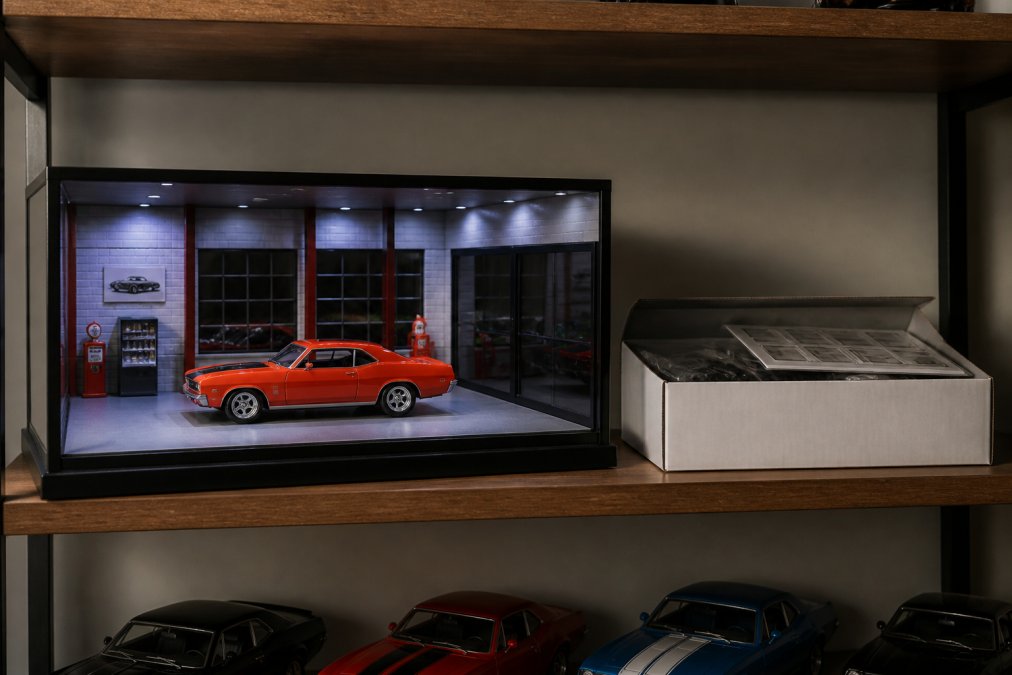
Pre-built dioramas range from roughly the cost of a single model car to several times that. At YCID, the 1/64 Crankys Speed Shop starts at $22.95, the 1/24 at $59.95, and the 1/18 at $114.95. The licensed Mr. Norms Grand Spaulding Dodge Showroom Diorama runs $249.95 in 1/18 scale. Those price points reflect the difference between a plug-and-display piece and a fully detailed, licensed replica.

Pre-Built vs. DIY Construction: A Real Cost Breakdown
A common mistake is comparing only a kit's sticker price against a finished diorama. The DIY route carries hidden costs: paint, adhesives, weathering supplies, lighting components, and tools. Add assembly hours, and the gap narrows fast.
| Factor | Pre-Built Diorama | DIY Build |
|---|---|---|
| Upfront cost | Fixed, known price | Kit plus supplies, often underestimated |
| Time investment | Minutes to a few hours | Days to weeks |
| Skill required | None to minor assembly | Painting, weathering, wiring |
| Finish consistency | Professional, repeatable | Varies with experience |
| Risk of rework | Low | High for beginners |
For collectors who want a display piece rather than a project, the pre-built route removes the largest variable: whether the result looks the way it did in your head.
Quality Standards in Professional Models
No industry body publishes a quality grade for pre-built dioramas the way grading services do for trading cards or coins. That absence is why two dioramas at the same price can differ wildly in build quality. The fix is to evaluate any piece against a repeatable rubric before you buy.
A Five-Point Build Quality Rubric
Score each category from 1 (poor) to 5 (museum-grade).
| Category | What to Inspect | Red Flags |
|---|---|---|
| Structural integrity | Wall alignment, base flatness, seam gaps, wobble when set on a level surface | Warped base, visible glue squeeze-out, walls that flex under light pressure |
| Paint and finish fidelity | Color match to the real subject, even coverage, no orange-peel texture, crisp masking lines | Runs, overspray on signage, brush strokes on what should be a sprayed surface |
| Signage and graphics | Legibility at arm's length, correct period fonts, straight application, no bubbles | Blurry print, wrong-era logos, decals peeling at corners |
| Lighting | Even coverage, no hot spots, switch accessibility, replaceable bulbs or LED strips | Sealed non-replaceable fixtures, flickering, visible wiring on the display side |
| Access and serviceability | Slide-out panels, removable roof, ability to swap models without dismantling the scene | Glued-shut enclosures, fragile parts that must be bent to access the interior |
Structural integrity and access are the two categories buyers underweight and later regret. A diorama with a beautiful facade but a glued-shut interior becomes a dust trap you cannot clean.
What 'Museum-Quality' Actually Means
Museum-quality is a marketing phrase, not a standard, but it maps to observable traits: straight walls, clean seams, signage matching the real location, and lighting that flatters the models rather than washing them out. The 1/18 Crankys Speed Shop shows how these details come together. It ships as two pieces, the building and a separate four-stall parking lot, so you can arrange the scene to fit your shelf.

A slide-out front panel lets you swap models without dismantling the scene. A removable roof section does the same from above. Ceiling lights with an on/off switch turn a static shelf into a display that reads well in a dim room. None of those features appear on a spec sheet, but each one is a scoring item on the rubric above.
How to Display 1:18 Scale Cars Without Damaging Paint
Displaying 1:18 scale cars without damaging paint comes down to three things: surface protection, light exposure, and dust control. Diecast paint is durable but not indestructible.
- Use a soft, non-abrasive surface under each model. Felt or foam padding prevents micro-scratches on the undercarriage and tires.
- Keep models out of direct sunlight. UV exposure fades paint and yellows clear plastic parts.
- Cover the display when not in use. An enclosed diorama with clear panels does this automatically; open shelves need regular dusting with a soft brush.
- Handle by the body, never by mirrors, spoilers, or antennae. Those are the first parts to snap.
A diorama with clear side and front panels solves the dust and light problems at once while still letting you see the models from every angle.
Custom Diecast Display Cases vs. Full Dioramas
Custom diecast display cases and full dioramas serve different purposes. A case protects and organizes; a diorama tells a story. For preservation, a case is enough. To recreate the showroom where a car was first sold, only a diorama delivers that.
The trade-off is space and cost. Cases stack and multiply; dioramas occupy a fixed footprint and reward you with atmosphere instead of capacity.
Diorama Building Materials for Beginners: What You Skip by Buying Built
Diorama building materials for beginners usually start with a kit, then expand into a list that grows every trip to the hobby shop: styrene sheet, acrylic paint, weathering powders, LED strips, wiring, and adhesives. Each has a learning curve.
Buying built skips that curve. The materials are already selected, cut, and finished. What you give up is the satisfaction of the build and the ability to customize every element.
For collectors who do want to build, the middle path works well. A partially assembled diorama like the 1/24 Crankys Speed Shop arrives with screws and a screwdriver included, plus a slide-out front panel and a reversible rooftop sign. You get the finishing touches without sourcing raw materials.
Scale and Detail Considerations: 1:18, 1:24, and 1:64
Scale determines how much detail a diorama can carry and how much space it demands. The three common scales each suit a different collector.
| Scale | Typical Diorama Price | Detail Level | Space Needed | Best For |
|---|---|---|---|---|
| 1:18 | $114.95 to $249.95 | Highest, working lights, licensed signage | Large shelf or cabinet | Display centerpieces |
| 1:24 | $59.95 to $74.95 | Moderate, printed interiors | Medium shelf | Mid-size collections |
| 1:64 | $22.95 to $39.95 | Printed detail, plug-and-display | Small shelf or desktop | Large collections, beginners |
The 1/64 Crankys Speed Shop arrives fully assembled, so it is plug-and-play with no build time. The 1/18 and 1/24 versions require minor assembly but reward that effort with more visible detail. The Yenko Chevrolet Dealership Diorama follows the same pattern: the 1/64 is plug-and-display, while the larger scales come unassembled with directions.

Resale Value and Depreciation of Pre-Built Dioramas
Resale value for pre-built dioramas behaves differently than for the models themselves. A diecast car kept new in box (NIB) typically holds value because the box is part of the collectible. A pre-built diorama has no equivalent sealed state: once it ships assembled, it is a used display piece, and the market prices it that way.
The NIB Versus Built Spread
The gap between a sealed kit and an assembled diorama is a depreciation factor, and it is structural rather than cosmetic. A sealed kit can be sold as new; an assembled diorama cannot, even if never displayed, because the seller cannot prove the assembly was done to factory standard.
Three traits separate pieces that hold value from pieces that do not:
- A documented production run, so buyers can verify scarcity.
- A recognizable real-world subject, such as an actual dealership, which anchors demand to a specific collector community.
- A manufacturer who stands behind the packaging, so pieces arrive intact and the buyer's risk is low.
Depreciation hits hardest on mass-produced, unbranded dioramas with no collector following. Those often sell used for a fraction of their original price because no secondary market competes for them.
Shipping Fragility Is the Hidden Cost Nobody Prices In
Shipping fragility is a factor in resale value. A diorama that arrives cracked or with broken signage loses most of its worth, and that risk sits with whoever ships it. The problem is geometry: a diorama is a hollow box with protruding details, close to the worst shape for parcel handling.
This is why a slide-out panel and a removable roof matter beyond convenience: they let the piece travel in a more compact, better-protected configuration. When evaluating a pre-built diorama for resale potential, ask three questions:
- Can the piece be broken down for shipping without tools?
- Are the fragile details (signage, light fixtures, antennae) removable or recessed?
- Does the original packaging include internal bracing, or is it just a cardboard box?
Maintenance and Repair Costs Over Time
Maintenance and repair costs are a factor collectors underestimate, and they compound depreciation. Lights burn out, clear panels scratch, and printed backdrops fade. Each is a value hit at resale because the buyer sees a piece that needs work.
A diorama with a USB-powered LED strip is easy to maintain because the light source is a replaceable part rather than a sealed fixture. A sealed fixture can be a liability: when the light dies, the piece either sells at a discount or needs a repair that may not match the original finish. The same logic applies to clear panels, which can be polished if removable and replaced if not.
Conclusion: When the Cost Makes Sense
Pre-built dioramas are worth the cost when your time is worth more than your labor, when you want a finished display rather than a project, or when the scene is a licensed replica you could not build yourself. They make less sense if the build is the point, or if you enjoy sourcing materials and weathering every surface by hand.
For collectors who want the result without the learning curve, YCID Diecast and Dioramas builds exactly that: 1:18, 1:24, and 1:64 scale display environments with slide-out panels, removable roofs, and ceiling lights, plus free US shipping on in-stock models for orders over $300. Start with a single piece like the Mr. Norms Grand Spaulding Dodge Showroom Diorama and see how it changes the way your collection reads on the shelf.
Frequently Asked Questions
What are the benefits of buying pre-built dioramas over DIY kits?
Pre-built dioramas arrive assembled or with minimal assembly, so you skip sourcing materials, cutting, painting, and weathering. You also get consistent structural integrity and a professional finish that is hard to match without experience. For collectors who want a display piece ready now rather than a months-long project, pre-built options save time and reduce the risk of a flawed build. Brands like YCID offer 1:64 versions that are plug-and-display with no assembly required.
How do professional dioramas impact the resale value of diecast collections?
A diorama does not typically raise the resale value of the cars themselves, since buyers price models on condition, rarity, and completeness. What a diorama can do is make a collection easier to photograph and present, which helps when selling. Treat the diorama as a display investment rather than a financial one. Expect depreciation on the diorama itself, especially if it shows wear or shipping damage.
What should collectors look for in a high-end display diorama?
Check the scale match to your models, the quality of the base and printed signage, whether lighting is included, and how the roof or front panel opens for swapping cars. Look for slide-out or removable panels so you can change models without disassembling the scene. Ask about assembly requirements and whether a USB adapter is needed. A removable roof, like on the Yenko Chevrolet diorama, makes rotating your collection far easier.
Are pre-built dioramas more durable than custom-built ones?
Durability depends on materials and construction, not on who built it. Factory-made pieces in PVC and acrylic often hold up well because tolerances are consistent. Custom builds vary widely depending on the modeler's skill and the materials used. The bigger risk for both is shipping damage. Ask how the diorama is packed, whether fragile parts ship separately, and what the damage policy covers before you buy.