Best Foam for Diorama Base Construction
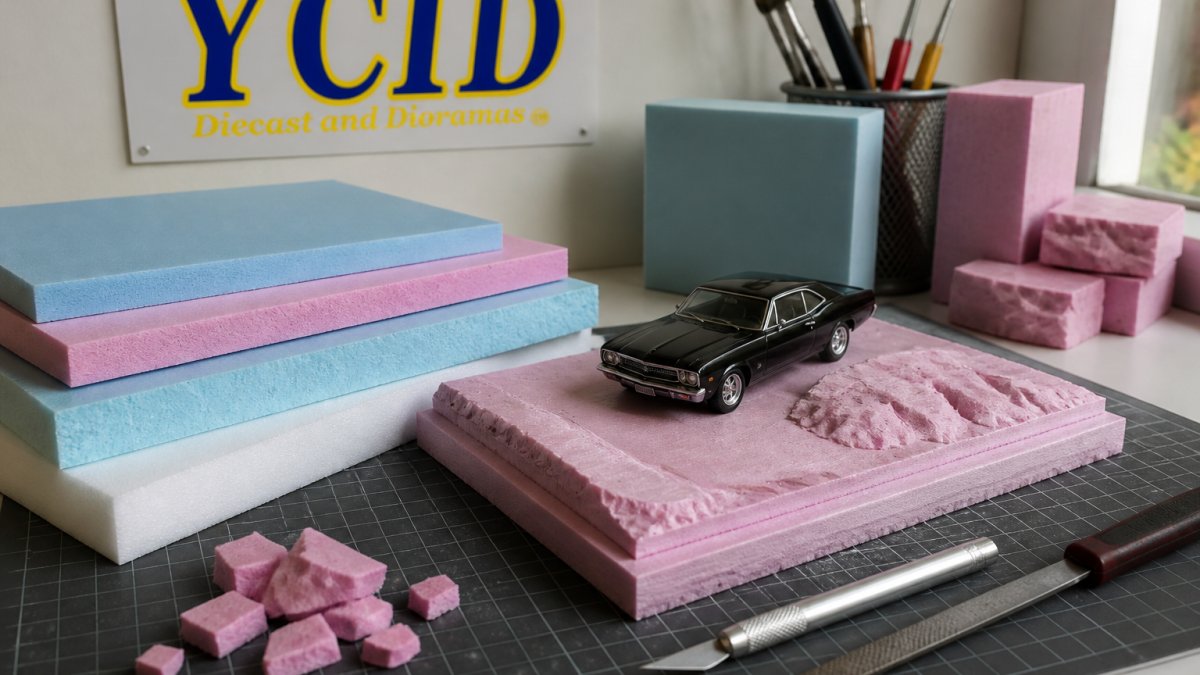
Table of Contents
- Why Foam Choice Matters for Your Diorama Base
- XPS Foam for Dioramas: Durability and Workability
- EPS Foam for Dioramas: Cost-Effective Alternative
- Foam Board for Model Dioramas: Lightweight and Rigid
- Diorama Base Thickness: Load-Bearing and Structural Considerations
- Material Comparison: Selecting the Right Foam
- Sourcing Foam and Managing Costs
- Common Mistakes When Selecting Foam for Diorama Bases
- Frequently Asked Questions
Last Updated: October 5, 2026
Why Foam Choice Matters for Your Diorama Base
Selecting the right foam for diorama base construction determines how well your 1:18 scale models showcase their detail. The choice affects structural integrity, workability, and longevity of your entire display environment.
Your foam base must support model weight without warping, accept adhesives and paint reliably, and remain rigid enough to hold its shape. The wrong choice leads to sagging displays, paint failures, and premature deterioration.
The best foam balances durability under load, ease of customization, and compatibility with finishing materials. Below are the major foam types, their strengths and limitations, and how to match them to your collection.
XPS Foam for Dioramas: Durability and Workability
XPS (extruded polystyrene) foam is the preferred choice for serious collectors. This closed-cell foam resists moisture, temperature changes, and maintains structural integrity over decades.
XPS foam's uniform, tightly packed cell structure won't crumble when carving terrain contours or cutting details. You can shape it with a hot-wire cutter, utility knife, or sand it smooth. This workability makes XPS ideal for elevation changes and complex terrain that complements your 1:18 scale models.
XPS foam accepts both water-based and solvent-based paints without degradation. Adhesives bond reliably to its surface, so you can attach landscape materials, model bases, and detail elements without worry. The rigid structure won't compress under the weight of multiple diecast cars positioned across the display.
XPS foam is denser and costs more per cubic foot than expanded foam. For large displays or budget-conscious collectors, this can be limiting. However, longevity and performance advantages typically justify the investment for permanent displays.
EPS Foam for Dioramas: Cost-Effective Alternative
EPS (expanded polystyrene) foam offers a lighter, economical option. This open-cell foam costs less than XPS while providing acceptable structural support for most displays.
EPS is practical for multiple smaller displays or frequent repositioning. Its lower density means less material weight for space-constrained setups.
The trade-off is workability and durability. EPS's coarser cell structure crumbles or chips when cut, producing rougher edges and more dust. It's also more susceptible to compression over time, especially under heavier model clusters.
Paint adhesion on EPS requires care. Solvent-based paints dissolve the foam, so use water-based acrylics or primer first. Some structural adhesives degrade EPS, limiting attachment options.
EPS foam for dioramas works best for temporary displays, experimental layouts, or collectors building on a minimal budget. If your collection will remain on display long-term, the durability limitations become more apparent.
Foam Board for Model Dioramas: Lightweight and Rigid
Foam board combines a thin foam layer between two sheets of paper or plastic facing, creating a lightweight, rigid panel that's easy to cut and assemble into modular bases.
Foam board is exceptionally easy to work with, a utility knife cuts cleanly in seconds. You can create geometric bases and tiered platforms without specialized tools. The paper facing accepts paint directly and won't warp.
Foam board's modularity allows rapid reconfiguration and tier adjustments without major reconstruction.
Foam board isn't ideal for organic terrain or complex elevation changes, its thin core lacks sculpting depth. The paper facing is susceptible to dents, tears, and moisture. Paint adhesion is less reliable than solid foam, and edges require finishing.
Foam board for model dioramas works best for structured, geometric displays where clean lines and modular assembly matter more than organic terrain detail. It's excellent for showcasing vehicle collections on tiered platforms or creating minimalist display environments.
Diorama Base Thickness: Load-Bearing and Structural Considerations
The thickness of your foam layer directly impacts how much weight it can support and how detailed your terrain can be. Selecting the right thickness prevents sagging, warping, and structural failure over time.
For 3-5 diecast models, 2-3 inches of foam provides adequate support with moderate carving capability and won't compress noticeably under typical weight.
Displays with 6-10 models benefit from 4-6 inches of foam, which distributes weight and prevents localized compression while enabling dramatic terrain sculpting.
Large displays with 10+ models should use 6-8 inches of foam minimum. Thicker material resists compression indefinitely and reduces vibration on shelves or tables.
Consider your display's permanence as well. Temporary arrangements can use thinner foam and accept minor compression. Permanent installations, displays that will remain in place for years, justify thicker material to ensure long-term stability and prevent gradual settling that eventually looks sloppy.
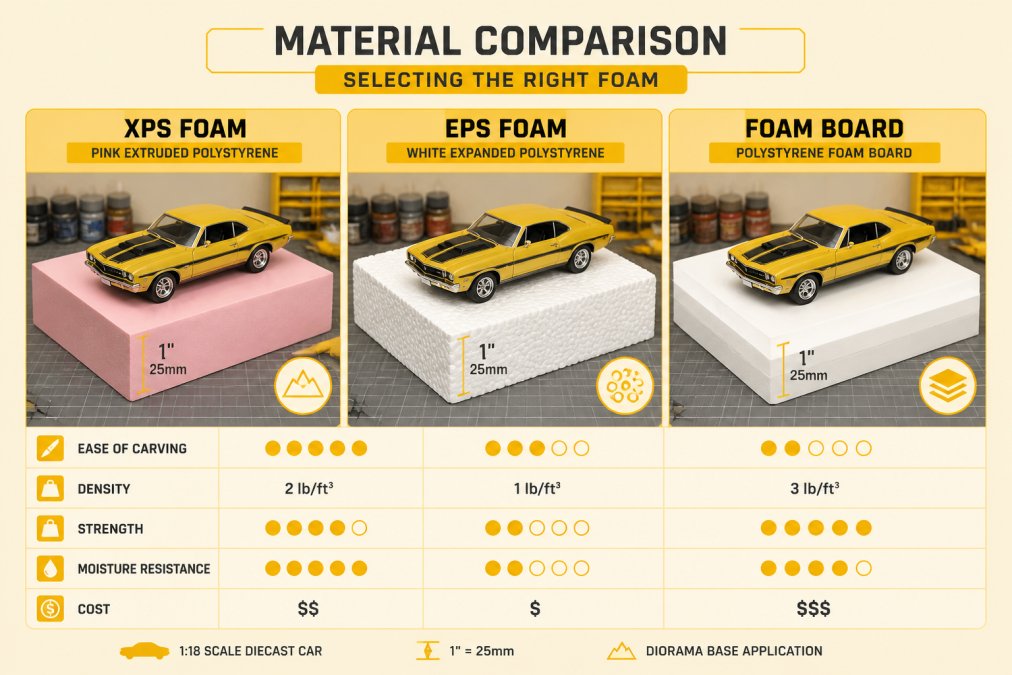
Material Comparison: Selecting the Right Foam
| Foam Type | Density | Workability | Paint Adhesion | Durability | Cost | Best For |
|---|---|---|---|---|---|---|
| XPS (Extruded Polystyrene) | High | Excellent | Excellent | 20+ years | Higher | Detailed terrain, permanent displays |
| EPS (Expanded Polystyrene) | Low | Moderate | Requires primer | 5-10 years | Lower | Budget builds, temporary layouts |
| Foam Board | Medium | Easy | Good | 5-8 years | Moderate | Geometric displays, modular setups |
Density and Cell Structure
Foam density determines both weight capacity and workability. Denser foams like XPS support more weight per square inch and resist compression better than lighter alternatives. The closed-cell structure of XPS means water and moisture can't penetrate the material, protecting it from mold and degradation in humid environments.
EPS has an open-cell structure where moisture can migrate through the material. This matters less for indoor displays in climate-controlled environments, but becomes a concern in basements, garages, or areas with temperature fluctuations. The lighter weight of EPS is an advantage only if your display needs to be portable, for static displays, the structural benefits of denser foam outweigh the weight savings.
Foam board's density falls between the two, but its paper facing becomes the limiting factor. The facing protects the foam core but is more vulnerable to damage than solid foam materials.
Cutting, Carving, and Surface Preparation
Different foam types require different approaches to achieve clean, detailed results. XPS foam cuts smoothly with a hot-wire cutter, producing precise edges and allowing intricate carving for realistic terrain. A utility knife also works well for straight cuts and basic shaping. The material doesn't crumble, so you can achieve fine detail without excessive cleanup.
EPS foam requires gentler handling. A hot-wire cutter works but produces more dust and rougher edges than XPS. Utility knives can tear the material if you apply too much pressure. For detailed work, you'll spend more time sanding and finishing to achieve polished results. The coarser cell structure means you'll accept some surface roughness that XPS would avoid.
Foam board cuts cleanly with a utility knife and straightedge, but only in straight lines. Curved cuts and organic shapes are difficult. The paper facing protects the foam during cutting but tears easily if your knife angle isn't precise. Once cut, foam board requires edge finishing, exposed foam edges look unfinished and are prone to damage.
Adhesive and Paint Compatibility
Material selection affects which finishing products work reliably. XPS foam bonds well with construction adhesives, spray adhesives, and contact cement. Paint, acrylic, latex, or solvent-based, adheres directly without primer. This compatibility makes XPS the most forgiving material for collectors experimenting with different finishing techniques.
EPS foam requires more careful adhesive selection. Solvent-based adhesives and paints can dissolve EPS, so you must use water-based products or apply primer first. This limitation means extra preparation steps and fewer product options. The tradeoff is cost savings, which matters if budget is your primary concern.
Foam board accepts water-based paints and adhesives reliably. The paper facing provides a natural substrate for paint. However, the foam core is sensitive to solvent-based products, so your finishing options are more limited than with solid foam materials.
Sourcing Foam and Managing Costs
Finding quality foam at reasonable prices requires knowing where to look. Home improvement retailers stock XPS and EPS insulation foam in standard thicknesses and sizes. These materials cost less than specialty diorama foam because they're purchased in volume for construction applications.
Insulation wholesalers and building supply distributors often have offcuts and overstock available at discounts. A phone call asking about foam scraps or damaged sheets can yield significant savings, especially if you're flexible about exact dimensions.
Online retailers specializing in hobby materials carry pre-cut foam sheets and specialty products designed specifically for model building. These cost more per unit but arrive ready to use without waste from cutting standard-sized sheets to fit your display dimensions.
Local foam fabrication shops sometimes sell remnants and can cut custom sizes to your specifications. Asking about leftover material from larger jobs can produce excellent deals on premium foam.
Comparing total cost requires accounting for material waste. A standard sheet might be larger than your display needs, meaning you'll discard offcuts. Ordering custom-cut material eliminates waste but costs more per unit.
Common Mistakes When Selecting Foam for Diorama Bases
Many collectors choose foam based on initial cost alone, overlooking long-term durability. A cheaper material might require replacement or refinishing within a few years, erasing the cost savings.
Another frequent error is underestimating thickness requirements. A thin foam base that seems adequate initially may compress noticeably under model weight within months. This compression creates an uneven surface that's difficult to correct without rebuilding.
Some collectors apply solvent-based products to EPS foam without realizing the material will dissolve. Testing adhesives and paints on scrap material before committing to your display prevents costly mistakes.
Neglecting to seal or prime foam surfaces leads to uneven paint absorption and poor adhesion. A primer coat ensures consistent finish and protects the foam from moisture and debris. This extra step takes minimal time but dramatically improves the final appearance.
Finally, many builders underestimate the importance of moisture management. Foam stored in damp environments or placed in humid locations can absorb moisture, leading to mold growth and material degradation.
Selecting the right foam for diorama base construction is foundational to building displays that remain visually impressive for years. The right material selection early on prevents frustration and costly rebuilds later.
Frequently Asked Questions
What is the best foam for a diorama base?
XPS (extruded polystyrene) foam is the top choice for diorama bases due to its closed-cell structure, which resists warping and crumbling. It's rigid, workable, and supports the weight of 1:18 scale models without sagging. EPS foam is a lighter, more affordable alternative, though it's more fragile. Foam board offers a middle ground for smaller displays or lightweight setups. Your choice depends on the size of your diorama, the weight it needs to support, and your budget.
How thick should foam be for a diorama base?
For 1:18 scale displays, use 2 to 4 inches of rigid foam to ensure adequate support and allow for terrain carving. Thinner foam (1 inch) works for lightweight, flat bases but offers limited detail options. Thicker foam (4+ inches) provides more sculpting flexibility and better load-bearing capacity for multiple models. Consider the total weight of your collection and the visual depth you want to achieve when deciding on thickness.
What is the difference between XPS and EPS foam?
XPS foam has a closed-cell structure, making it denser, more durable, and resistant to moisture and crumbling. It cuts cleanly and holds fine detail. EPS foam uses an open-cell structure, making it lighter and cheaper but more prone to fragmentation and warping over time. XPS typically costs more but lasts longer and handles the weight of diecast models more reliably. For serious collectors building lasting display environments, XPS is the better investment.
Can foam support a diecast model car?
Yes, rigid foam can support 1:18 scale diecast models when properly selected and installed. XPS and quality foam board both handle the weight without sagging or compressing. The key is using adequate thickness (at least 2 inches) and ensuring the foam is fully supported underneath, avoid bridging or unsupported sections. Avoid low-density foam or thin sheets, which may compress under a model's weight over time, causing an uneven display surface.