Collecting 1:18 Scale American Muscle Cars: 2026 Guide
Table of Contents
- Why 1:18 Scale American Muscle Cars Became the Collector Standard
- The Best 1:18 Diecast Brands and Production Eras to Know
- What Separates a Collector-Grade Replica From a Shelf Filler
- Condition Grading, Pricing, and What Drives Collector Market Value
- How to Display Diecast Cars Without Damaging Them
- Diecast Car Maintenance Tips for Long-Term Value
- Authentication, Counterfeits, and Protecting Your Investment
- Frequently Asked Questions
Last Updated: September 17, 2026
Why 1:18 Scale American Muscle Cars Became the Collector Standard
The 1:18 scale occupies a sweet spot in diecast collecting: large enough to show real detail, small enough to fit a shelf. That balance is why collecting 1:18 scale American muscle cars has become the most popular niche in the hobby, and why this guide from YCID Diecast and Dioramas focuses on it.
From Toy Aisles to Display Cabinets: A Short History
Early diecast cars were children's toys, sold cheaply and played with hard. That changed as manufacturers began tooling dedicated collector lines with finer casting and more parts. Adult hobbyists drove the shift, and the 1:18 scale became the format where makers could show off the most detail. Today the collector market treats these models as display pieces first and toys a distant second.
Diecast Metal vs Resin: What Each Material Means for Your Shelf
Diecast models are cast in metal, usually a zinc alloy, which gives them weight and a satisfying heft. Resin models are cast in a poured polymer, which allows finer surface detail and lower production runs, but they are lighter and more fragile.
| Material | Weight | Moving Parts | Best For |
|---|---|---|---|
| Diecast metal | Heavy | Common | Handling, opening features |
| Resin | Light | Rare | Static display, fine detail |
The Best 1:18 Diecast Brands and Production Eras to Know
The best 1:18 diecast brands are the ones that invested in accurate tooling and honest production numbers. Tooling is the master mold a model is cast from, and it decides how accurate every panel gap and body line will be. Two models of the same car from different makers can differ by millimeters in wheelbase and still look wrong side by side, because the tooling, not the paint, sets the geometry.
The Brands That Built the Category
A handful of makers shaped what collectors expect from a 1:18 muscle car today:
- Ertl / American Muscle, long associated with American iron, including the American Muscle line that put affordable, accurate Mustangs, Camaros, and Chargers on shelves for decades.
- GMP (Georgia Marketing & Promotions), known for high-detail, limited-run muscle cars with opening panels and correct engine bays, often produced in runs of a few hundred to a few thousand.
- Highway 61 / Die Cast Promotions, a premium line that pushed detail on Mopar and GM muscle, frequently cited for accurate stance and interior trim.
- Auto World, a modern maker that licenses original tooling and reissues classic castings, which is why some new releases match or beat vintage examples on accuracy.
- GreenLight Collectibles, strong on licensed, era-correct graphics and police/tv tie-ins, with a broad muscle car catalog.
- Maisto and Welly, entry-tier makers whose 1:18 muscle cars are widely available at retail; useful for display variety, but typically lighter on opening features and engine detail than collector-grade lines.
Production Eras and Why They Move Value
Production eras matter just as much as brand. A common pattern in this hobby is that older runs from retired or revised tooling hold value because the mold no longer exists in its original form. When a maker retires a mold, the surviving examples become the only ones with that exact geometry, and collectors notice.
Three broad eras are worth knowing:
- Vintage toy era (pre-1980s), diecast was built for play, with simpler castings and fewer moving parts. Surviving examples in mint condition are scarce because most were handled hard.
- Collector-line era (1980s-1990s), makers began tooling dedicated adult collector lines with finer casting, opening hoods, and licensed graphics. This is where many of the castings collectors still chase were born.
- Modern precision era (2000s-present), resin and high-detail diecast pushed surface accuracy further, and limited runs with certificates of authenticity became standard for premium releases.
What to Check Before You Buy
- Confirm the maker and, if claimed, the production run size.
- Look for a certificate of authenticity and a numbered box sticker on any limited release.
- Compare panel gaps and stance against reference photos of the real car.
- Check whether the tooling has been revised; a revised mold can change proportions subtly.
At YCID Diecast and Dioramas, every release is built around collector-grade tooling rather than generic castings. A good example is the YCID #35, 1969 COPO Camaro, 427, 4 speed, a replica of a car featured in HOT ROD magazine, limited to 199 units with a COA and numbered box sticker.

What Separates a Collector-Grade Replica From a Shelf Filler
The difference comes down to three things: working features, finish quality, and scale accuracy. A shelf filler looks right from across the room. A collector-grade replica holds up under a magnifier.
Opening Doors, Steerable Wheels, and Engine Detail
Opening doors and hoods should align flush when closed and swing without binding. Steerable wheels should turn smoothly through the front linkage. Engine detail should show correct components for the specific car, not a generic block dropped into every model.
Paint Finish, Interior Detailing, and Scale Accuracy
Paint should be even, with no orange peel or thin spots along panel edges. Interior detailing should match the real car's trim, seats, and dash layout. Scale accuracy means proportions are correct: wheelbase, roof line, and stance all read as the actual vehicle.
Condition Grading, Pricing, and What Drives Collector Market Value
Condition is the single biggest driver of value, followed by rarity and originality. A model in mint condition with its original packaging will always outsell the same model loose, even if the loose car is flawless. But "condition" is not one thing, it is a stack of factors, and each one moves price independently.
The Grading Tiers Collectors Actually Use
Most collectors and sellers work from a small set of tiers:
- Mint in box (MIB), unused, still in original packaging, with all inserts, paperwork, and the certificate of authenticity if one was issued. This is the top tier and the reference point for every other grade.
- Near mint in box, box may show shelf wear, but the model is untouched and complete.
- Mint loose, model is perfect but has been removed from the box. Loses value against MIB even when the car itself is flawless.
- Loose, displayed, model shows handling wear: micro-scratches, dust in panel gaps, or slight hinge looseness from opening features being cycled.
- Played-with / damaged, missing mirrors, bent axles, chipped paint, or broken hinges. Value drops sharply and often only makes sense as a parts donor or restoration candidate.
What Actually Moves the Price
Beyond the grade, four factors do most of the work:
- Production run size, a run of 199 cars will always be scarcer than an open-stock release. Limited runs should come with proof: a certificate of authenticity and a numbered box sticker are the standard evidence, and collectors should expect both on any "limited edition" claim.
- Originality, original paint, original decals, and original parts matter. A repainted or repaired model is a different asset, even if it looks better.
- Box and documentation completeness, a matched COA, box, and inserts sell as a package. A separated certificate is a common reason a sale stalls.
- Tooling reputation, a casting from a respected mold holds value better than a generic one, even at the same grade.
Documenting Your Collection for Insurance and Valuation
This is the step most guides skip, and it is the one that protects you when something goes wrong. Serious collectors treat documentation as part of the hobby, not an afterthought.
- Photograph each model from multiple angles, including the base plate, any serial or run number, and the COA.
- Record what you paid and when, and keep receipts, auction records, and COAs together in one place.
- Keep a running inventory, maker, model year, scale, run size, grade, and current estimated value.
- Review your insurance. Homeowners or renters insurance may cover a collection under contents coverage, but high-value pieces often need a scheduled rider or a separate appraisal. Check your policy and document everything before you need to file a claim.
A Note on Pricing
Prices for 1:18 muscle cars range widely by maker, run size, and grade. Rather than chase a single number, track recent sold listings for the exact model and grade you own, and compare against the same casting in MIB condition. The spread between a loose example and a documented MIB example of the same car is usually the clearest signal of what documentation and condition are worth.
How to Display Diecast Cars Without Damaging Them
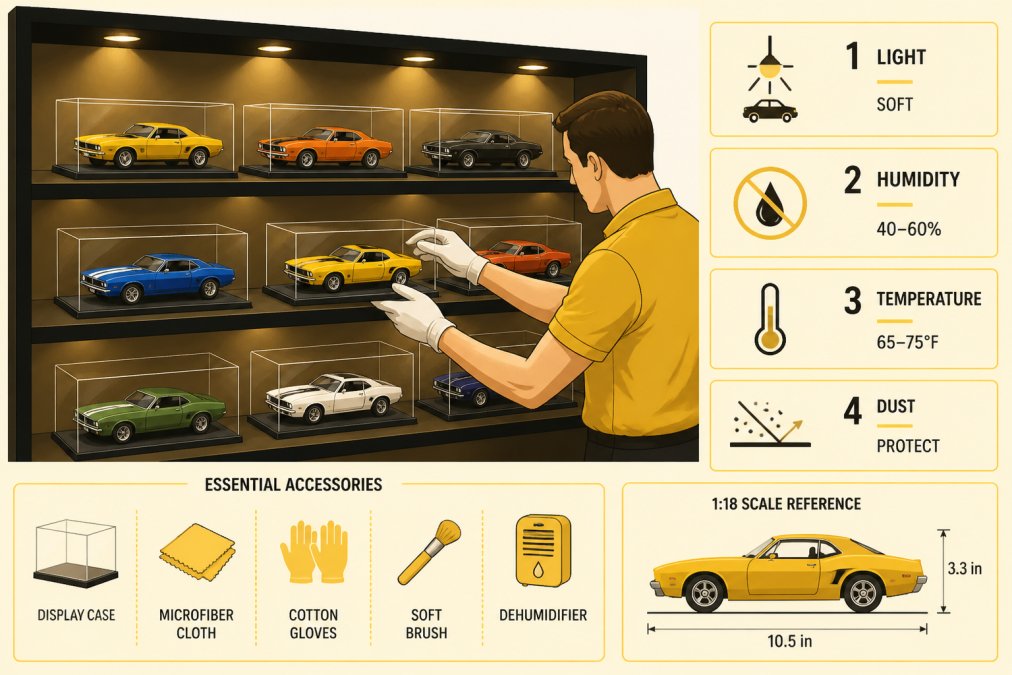
Display damage is the most preventable loss in this hobby, and it comes from three sources: UV light, dust, and physical contact. A display case solves all three.
Diecast Car Maintenance Tips for Long-Term Value
Diecast car maintenance tips come down to gentle, infrequent care. Dust with a soft brush or microfiber cloth rather than compressed air, which can drive grit into panel gaps.
Authentication, Counterfeits, and Protecting Your Investment
Counterfeits exist in this hobby, and most give themselves away through small errors. Check panel gaps, paint thickness, and whether the casting matches known tooling for that model.
Frequently Asked Questions
Who makes the best 1:18 scale diecast cars?
There is no single winner because the best brand depends on what you value. Some makers focus on opening doors, steerable wheels, and detailed engine bays; others prioritize paint finish and interior detailing. Production era matters too, since older tooling often carries more collector weight. For American muscle cars specifically, look at scale accuracy, chassis detail, and whether the model comes with a certificate of authenticity. YCID Diecast and Dioramas builds limited-run 1:18 scale muscle cars, with runs as small as 60 to 199 units depending on body style.
What is the difference between budget and premium 1:18 diecast brands?
Budget 1:18 scale models usually cut corners on interior detailing, tire tread, and suspension parts, and they often skip the certificate of authenticity. Premium replicas use diecast metal bodies with finer paint finish, accurate chassis and engine detail, and numbered production runs. The price gap reflects tooling cost and run size, not just branding. A 199-unit run costs more per car to produce than a mass-market release, which is why collector-grade 1:18 scale American muscle cars typically start around $140 and climb with rarity.
How do I properly clean and maintain 1:18 scale diecast models?
Use a soft microfiber cloth and a dry, soft-bristle brush for dust on the paint finish and interior detailing. Avoid household cleaners, which can dull paint or damage decals. Keep models out of direct sunlight and away from humid rooms, since both accelerate paint fade and metal corrosion. Handle cars by the chassis, not the hood or trunk, to protect opening doors and hinges. For long-term storage, use acid-free tissue and keep the original box and COA, because mint in box condition holds far more value than a loose model.
How should I display my 1:18 scale muscle car collection?
Display cases with UV-filtering acrylic protect paint finish from fading and keep dust off engine detail and interior detailing. Keep shelves out of direct sunlight and away from heating vents, which dry out tires and decals. Rotate models occasionally so weight does not sit on suspension parts in one position. If you want a scene rather than a shelf, dioramas in 1:18, 1:24, and 1:64 scales let you group cars by era or theme. Measure your space first, since a single 1:18 scale model runs about 10 to 12 inches long.
How can I tell if a limited edition 1:18 diecast is authentic?
Check for a numbered box sticker, a certificate of authenticity, and documentation that matches the stated production run. Limited edition claims should name an exact number, such as 199 coupes or 60 convertibles, not vague wording. Compare paint finish, panel gaps, and interior detailing against known photos of the real car. Counterfeiters often get scale accuracy close but miss chassis stamps or tire branding. Buy from sellers who show the COA and box sticker in listing photos, and keep that paperwork with the model.
What are the most sought-after American muscle cars for collectors?
Demand clusters around a few icons: the 1970 Plymouth Cuda, 1970 Dodge Challenger R/T, and late-1960s Camaro and Mustang variants. Cars tied to a documented real vehicle, a magazine feature, or a famous film tribute carry extra weight. The 1969 ZL1 Camaro and 1969 COPO Camaro 427 are good examples, since both represent rare factory combinations. Limited edition runs of these models, especially convertibles with runs under 100 units, tend to sell out fastest in the collector market.
Should I keep my diecast cars in the box or display them loose?
Both approaches work, but they serve different goals. Mint in box models with the original packaging and COA generally hold more value because condition is verifiable and the box protects paint finish during storage. Loose display lets you enjoy opening doors, engine detail, and interior detailing up close. Many collectors do both: keep one example boxed as an investment and display a second copy. If you display loose models, use a sealed case and keep the box stored flat, dry, and out of sunlight.
What should I check before buying a 1:18 scale muscle car online?
Confirm the model is actually in stock, not a preorder with an open ship date. Ask about packaging standards, since paint chips and misaligned doors usually trace back to poor packing, not factory defects. Check the return policy for shipping damage. Verify the production run size and whether a certificate of authenticity is included. If the listing shows the exact car being replicated, compare details like stripe placement and wheel style. Reputable sellers document all of this in the product photos before you order.
The hardest part of collecting 1:18 scale American muscle cars is not finding models, it is finding them in the condition and run size you actually want. YCID Diecast and Dioramas builds collector-focused 1:18 scale American muscle cars with documented limited runs, numbered COAs, and precision display dioramas in 1:18, 1:24, and 1:64 scales, with free US shipping on in-stock models over $300. Get started with YCID Diecast and Dioramas and display a collection built to hold its value.