Do Dioramas Fit Other Brand Models? A Compatibility Guide
Table of Contents
- Understanding Scale and Compatibility
- Will a 1:18 Car Fit a 1:18 Diorama?
- Diecast Car Dimensions and Measurement
- Diorama Size Guide for Model Cars
- Compatibility Across Different Manufacturers
- Choosing the Right Diorama for Your Collection
- Frequently Asked Questions
Last Updated: October 19, 2026
Understanding Scale and Compatibility
When adding models from different manufacturers to your collection, the first question is whether dioramas fit other brand models in a display. The answer depends almost entirely on scale matching and physical dimensions rather than brand loyalty. At YCID Diecast and Dioramas, the core principle is consistent: scale is the foundation of compatibility.
Scale is the proportional relationship between a miniature model and its real-world counterpart. A 1:18 scale diecast car is 1/18th the size of the actual vehicle. When evaluating whether dioramas fit other brand models, you're really asking whether proportions and dimensions align.
However, theory and practice diverge. Manufacturing tolerances, design choices, and intended use cases create real differences in how models and dioramas interact.
Will a 1:18 Car Fit a 1:18 Diorama?
Yes, a 1:18 scale diecast car will generally fit inside a 1:18 scale diorama, but fit quality depends on specific measurements rather than scale designation alone.
Scale Matching as the Starting Point
Scale matching is your baseline compatibility check. A 1:18 car and a 1:18 diorama share the same mathematical ratio, so the car won't look oversized or undersized inside. When proportions match, the scene reads authentically and details feel cohesive. That said, matching scale labels doesn't guarantee physical fit, two manufacturers might both claim 1:18 but apply slightly different measurement standards or leave varying interior space.
Footprint and Clearance Considerations
The actual dimensions of your diecast car determine whether it physically fits. Footprint (floor space) and clearance (vertical and horizontal space) are the real constraints. A typical 1:18 scale muscle car measures roughly 9-11 inches long and 3-4 inches wide; most 1:18 dioramas offer interior widths of 12-16 inches and depths of 10-14 inches. Clearance height matters equally: if your diorama has a ceiling or roof detail, verify the interior height accommodates your model (usually 3-4 inches). A low-slung sports car fits easily; a lifted truck or van may not.
The Society of Automotive Engineers standards document scale specifications that many manufacturers reference, though individual production choices still create variation.
Diecast Car Dimensions and Measurement
Before purchasing a diorama, measure your diecast car in three dimensions, length, width, and height, with a ruler or digital caliper. Record these and compare them against the interior dimensions of any diorama you're considering. That simple step is where most cross-brand fit questions are actually settled.
Scale Conversion: From Label to Inches
Scale is a ratio, so you can predict a model's size before it arrives. If you know the real vehicle's published length, divide by 18 to estimate the model's length: a 180-inch coupe becomes roughly 10 inches at 1:18; a 200-inch full-size becomes about 11.1 inches.
| Scale | Divide real dimension by |
|---|---|
| 1:18 | 18 |
| 1:24 | 24 |
| 1:64 | 64 |
Use the conversion as a sanity check, then measure the actual model. Tooling choices, opening panels, and base thickness can shift a model a few tenths of an inch from the theoretical figure, and a few tenths is often the difference between a comfortable fit and a tight one.
Which Dimensions Actually Matter
Length is typically the least problematic dimension. Width matters when displaying multiple models side by side, because side clearance shrinks fast in a two-car bay. Height is where surprises occur, especially with enclosed designs or detailed roof structures. Measure width at the widest body point (usually the rear fenders), height from the tire contact patch to the roof's highest point, and length bumper to bumper including protruding details. Compare these to the diorama's interior width, depth, and height.
A Worked Comparison
Suppose you're considering the American Muscle Car 2 Car Garage, which measures 15.5 inches wide by 14.5 inches deep by 8 inches tall. A 1:18 muscle car model at roughly 10.5 inches long, 4 inches wide, and 3.5 inches tall fits with room to spare: about 1.75 inches of side clearance per model, roughly 4 inches of depth margin, and more than 4 inches of headroom. A taller 1:18 van at 5 inches still clears the 8-inch interior height, but a lifted truck at 5.5 inches leaves less margin and is worth measuring before you commit. Physical measurement removes guesswork across manufacturers, since one producer's 1:18 may differ slightly from another's.
Verifying Before You Buy
Compare your three model measurements against the diorama's stated interior dimensions, not its exterior footprint. If a listing gives only exterior size, treat the interior as smaller by the wall and frame thickness and confirm with the seller. At least 0.5 inch of side clearance and 0.25 inch of headroom displays cleanly without looking crammed.
Diorama Size Guide for Model Cars
Diorama interior dimensions determine how many models you can display and how comfortably. A single-car garage diorama typically measures 15-16 inches wide by 10-14 inches deep, accommodating one 1:18 model with modest clearance.
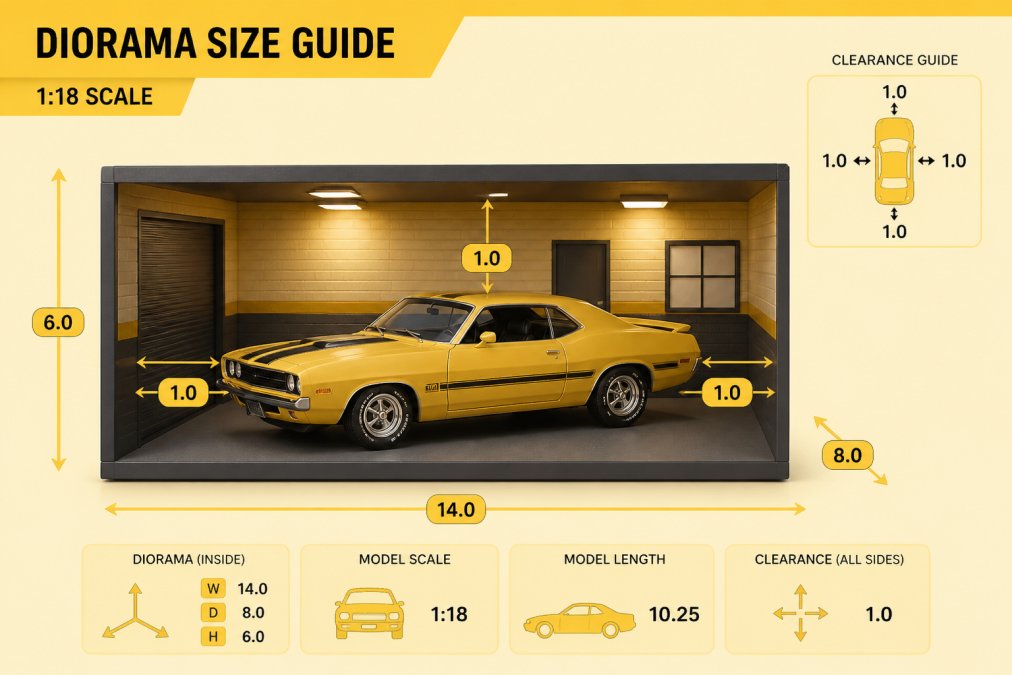
Two-car displays like YCID's 1:18 scale American Muscle Car 2 Car Garage measure 15.5 inches wide by 14.5 inches deep by 8 inches tall, holding two 1:18 models side by side with reasonable spacing.
1/18 scale Universal 2 Car Garage →

Compatibility Across Different Manufacturers
The real compatibility question isn't whether brands work together, it's whether specific models fit specific dioramas based on actual dimensions. That distinction is where most cross-brand displays succeed or fail.
The Direct Answer
Yes, dioramas fit models from other brands, provided three conditions hold: the scale ratios match, the model's footprint and height fall inside the diorama's interior clearances, and any mounting features on the model's underside either match the diorama floor or can be bypassed by resting the model freely. Brand name is not a compatibility factor. A 1:18 diecast from one maker will sit in a 1:18 diorama from another maker as long as the measurements line up.
What Determines Real Fit
Fit depends on four measurable factors: model length, model width, diorama interior width, and diorama interior height. A model fits if its length is shorter than the diorama's depth, its width fits within the diorama's width, and its height fits the available vertical space. Collectors leave at least 0.5 inch of clearance on each side and 0.25 inch above the roof so the model doesn't read as wedged in. Mounting points matter too: some dioramas include display stands or base attachments for a particular size range, so verify your model's mounting footprint aligns with the diorama's support structure. Some collectors prefer models that rest freely; others use mounting hardware for stability.
Compatibility Matrix Across Model Types
Use this as a starting screen before you measure. It reflects common patterns across 1:18 diecast collections; always confirm against the specific product's stated interior dimensions.
| Model type | Typical footprint (L x W x H, inches) | Works in a single-car 1:18 diorama? | Works in a two-car 1:18 diorama? | Notes |
|---|---|---|---|---|
| 1:18 diecast coupe or sedan | 9-11 x 3-4 x 3-4 | Yes | Yes, two side by side | Most common case; verify roof clearance in enclosed designs |
| 1:18 diecast muscle car | 10-11 x 3.5-4 x 3-4 | Yes | Yes, with tighter spacing | Wider bodies reduce side clearance |
| 1:18 diecast pickup or SUV | 10-12 x 3.5-4.5 x 4-5 | Usually, check height | Often, check height and width | Taller roofs can hit enclosed ceilings |
| 1:18 diecast van or lifted truck | 10-12 x 4-4.5 x 4.5-5.5 | Sometimes | Rarely two at once | Height is the usual failure point |
| 1:24 diecast | 6-8 x 2.5-3 x 2-3 | No, undersized | No | Reads as a toy next to 1:18 scenery |
| 1:64 diecast | 2.5-3 x 1-1.5 x 1-1.5 | No | No | Needs a dedicated 1:64 diorama |
| 1:18 figures and accessories | Varies | Yes, as scene dressing | Yes | Scale match matters more than brand |
Brand-Specific Caveats and Verification Method
Even products labeled with the same scale can differ: one maker's 1:18 body may run slightly wider or taller than another's due to tooling, opening panels, or base thickness. Rather than trusting the label, verify in four steps:
- Pull the product's stated interior dimensions from the listing or packaging, interior width, depth, and height, not exterior size.
- Measure your model: length bumper to bumper, width at the widest body point (usually the rear fenders), and height from tire contact patch to roof.
- Compare model dimensions to interior dimensions and confirm at least 0.5 inch of side clearance and 0.25 inch of headroom.
- Inspect the model's underside and the diorama floor for pegs, holes, or tabs. If they don't match, plan to rest the model freely.
Adaptation Options When Parts Do Not Fit
When a model is close but not quite right, collectors typically resolve it by repositioning the model, reducing the load, or switching the diorama to a larger bay or an open-floor design such as the 1/18 scale Universal 2 Car Garage, which accommodates models with and without mounting points.
Mounting Points and Attachment Details
Mounting points are the physical features that secure a model to a diorama floor. Some 1:18 diecast cars include small pegs or holes on their underside designed to fit corresponding receptacles in a display base; others rest freely. YCID dioramas like the 1/18 scale Universal 2 Car Garage and the American Muscle Car 2 Car Garage feature flat display floors that accommodate both types, so you can display models from various manufacturers without matching attachment hardware. Inspect your model's underside and the diorama's interior floor: matching features make attachment straightforward, and if one or both lack mounting hardware, the model simply sits freely, perfectly acceptable for most displays.
Choosing the Right Diorama for Your Collection
Selecting a diorama involves three decisions: scale, size, and style. Next, evaluate size: a single-car garage suits collectors with 2-5 models, two-car configurations work for 6-15, and multi-level dealership displays accommodate 15+ across separate floors.

The Automotive Enthusiasts Association resources provide guidance on display standards and best practices for scale-model collections.
Compatibility between dioramas and other brand models comes down to precise measurement and understanding the physical constraints of your specific pieces. Our dioramas accommodate quality diecast models and provide the professional presentation your collection deserves. Add a 1/18 scale American Muscle Car 2 Car Garage to your collection today and see how precision engineering transforms a simple display into a showcase.
Frequently Asked Questions
Do dioramas fit diecast models from other brands?
Yes, dioramas can fit models from different manufacturers if the scale matches and the car's dimensions align with the interior space. Scale compatibility (1:18 to 1:18, for example) is the foundation, but you must also verify the actual footprint and clearance. A 1:18 diorama holds 1:18 models regardless of brand, as long as the model's length, width, and height stay within the diorama's interior dimensions. Check both the model's specifications and the diorama's measurements before purchasing.
How do I check whether a 1:18 car fits a diorama?
Measure the diecast car's length, width, and height, then compare those dimensions to the diorama's interior space. Most 1:18 diecast cars range from 8 to 11 inches in length. Check the diorama's interior dimensions, including ceiling height and side-to-side clearance. For example, the 1/18 scale Universal 2 Car Garage measures 15.5 inches wide by 14.5 inches deep by 8 inches tall inside, comfortably fitting two 1:18 models side by side. Always account for the model's mirrors, spoilers, or other protruding parts when measuring clearance.
Does matching scale guarantee that a model will fit a diorama?
Matching scale is necessary but not sufficient. Two items marked 1:18 scale can still have different actual dimensions due to design variations. A scale match means the proportions are correct, but the physical fit depends on the specific car's footprint and the diorama's interior space. Always verify the model's exact dimensions and compare them to the diorama's usable interior dimensions. Some 1:18 models are longer or taller than others, so the scale alone doesn't ensure they'll fit side by side or with headroom to spare.
What should I check before buying a diorama for a model car?
First, confirm the diorama's scale matches your model's scale. Second, measure your diecast car and compare its length, width, and height to the diorama's interior dimensions. Fourth, verify the diorama has a front access panel or opening so you can position and remove the model easily. Finally, consider how many models you plan to display and whether they'll fit without touching each other or the walls, which can cause paint damage over time.