How to Check Diecast Model Stock: A Collector's Guide
Table of Contents
- Why Checking Diecast Model Stock Matters
- Direct Retailer Websites and Inventory Systems
- Using Diecast Inventory Software to Track Stock
- Exploring Online Marketplaces and Auction Results
- Finding an Awesomediecast Alternative for Muscle Cars
- Using a Diecast Value Guide to Assess Rarity and Market Trends
- Verifying Authenticity and Condition Before Purchase
- Frequently Asked Questions
Last Updated: September 25, 2026
Why Checking Diecast Model Stock Matters
Knowing how to check diecast model stock is essential for serious collectors. The difference between securing a limited-edition 1:18 scale muscle car and missing out often comes down to timing and access to real-time inventory data.
Limited-run models sell out fast. A car listed as "in stock" may be backordered at shipping, or you'll miss a release entirely without knowing where to look.
Rare diecast models appreciate over time. Checking stock properly means securing an investment, not just buying a model.
Knowing how to check diecast model stock separates successful collectors from frustrated ones.
Direct Retailer Websites and Inventory Systems
Most diecast retailers display stock status directly on product pages. Learning to read these indicators saves time and prevents disappointment.
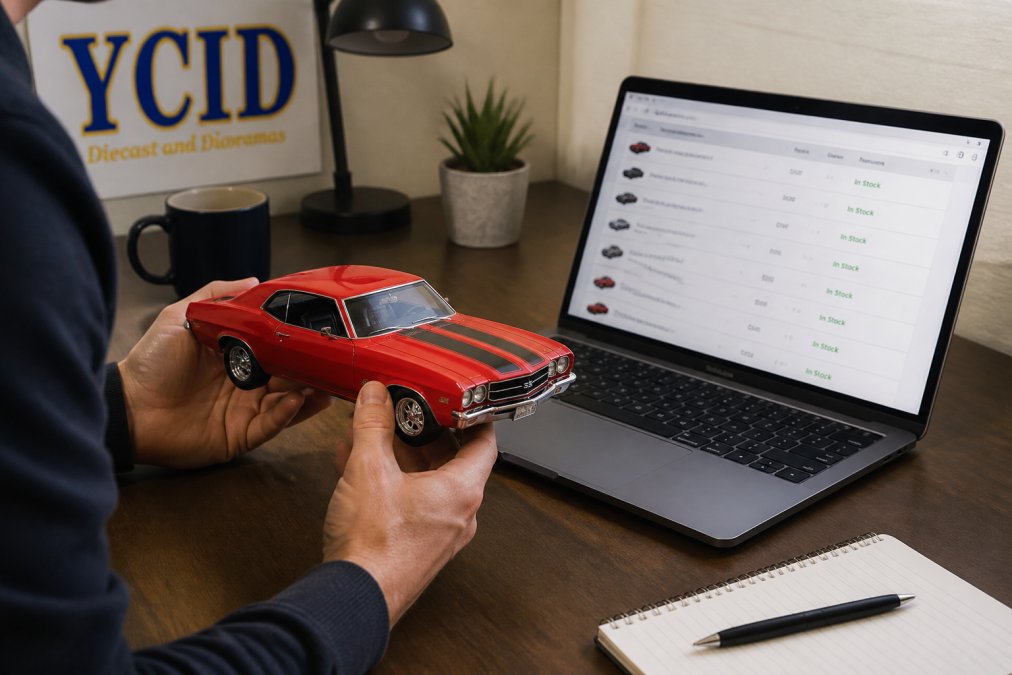
Reading stock indicators and availability badges
Retailers use different terminology for inventory status. You'll see labels like:
- In Stock, Item is available and ready to ship
- Limited Stock, Few units remaining; order soon
- Pre-order, Available for future shipment on a specific date
- Backorder, Sold out but may be restocked; you can reserve one
- Out of Stock, Not currently available with no restock date
Pay attention to quantity indicators. Some sites show exact numbers ("3 remaining") while others use vague language ("Low stock"). Exact numbers are more reliable.
Color-coded badges matter too. Green typically means available. Yellow or orange signals limited availability. Red means sold out. Don't assume these standards apply everywhere, check the retailer's key.
Contacting retailers for real-time confirmation
Call or email the retailer directly for current information. Ask if the item is physically in stock, typical shipping timeframe, quantity available, and return policy. A two-minute call prevents ordering an "in stock" item that won't ship for six weeks.
Using Diecast Inventory Software to Track Stock
Serious collectors use software tools to monitor multiple retailers and maintain detailed records. These systems save hours of manual checking and provide documentation for insurance and tax purposes.
Database tools for cataloging your collection
Popular options include spreadsheet-based systems (free but manual), dedicated diecast apps with barcode scanning and price lookups, general inventory software like Airtable, and manufacturer databases like Hot Wheels' official checklists.
These tools track model details, purchase and market value, condition, acquisition date, photos, wishlist items, and replacement cost for insurance.
A database prevents duplicate purchases, reveals price drops, and provides documented proof of ownership and value for insurance claims.
Automated barcode and QR scanning for rapid inventory entry
Barcode scanning apps reduce entry time from 3-5 minutes per model to under 30 seconds by automatically populating model data from linked databases. You add only purchase price, condition notes, and photos.
Some retailers add QR codes linking to valuation data. Barcode apps typically cost $2-5 monthly or $10-25 one-time, justified by time savings for active collectors.
Setting up automated stock alerts across multiple retailers
Enable email or SMS alerts on retailer product pages for models you're actively hunting. Be selective, focus on specific variants to avoid alert fatigue.
Third-party alert services monitor multiple retailers simultaneously for stock changes and price drops, costing $5-15 monthly.
Documenting collection value for insurance and tax purposes
Inventory software creates professional documentation for insurance (itemized list, photos, receipts, replacement cost) and tax purposes (income reporting, donations, casualty losses). Export as PDF with photos for insurance adjusters and tax authorities.
Track acquisition cost versus current market value to document appreciation. Some insurers offer 5-10% discounts for detailed inventory documentation.
Exploring Online Marketplaces and Auction Results
Online auction sites show real market value through completed sales. Check final prices, bid counts, sale speed, and condition descriptions. Multiple listings signal common models; scarce listings indicate genuine rarity.
Finding an Awesomediecast Alternative for Muscle Cars
Collectors often ask where to find quality 1:18 scale American muscle cars beyond their usual sources.
The diecast market includes multiple retailers, each with different inventory, pricing, and specialization. Some focus on Japanese imports. Others specialize in European sports cars. A few concentrate exclusively on American muscle.
Evaluating alternatives means checking:
- Do they stock the specific year and variant you want?
- What's their return policy if a model arrives damaged?
- How quickly do they ship?
- Do they offer pre-orders for upcoming releases?
- What's their reputation in collector communities?
YCID Diecast and Dioramas specializes in high-quality 1:18 scale American muscle cars with precision-crafted display dioramas.
Using a Diecast Value Guide to Assess Rarity and Market Trends
A diecast value guide helps you understand what models are actually worth and whether a price is fair.
Value guides track:
- Average sale prices for each model
- Price trends over time (rising or falling)
- Rarity ratings based on production numbers
- Condition premiums (how much better condition adds to value)
- Market demand by scale and manufacturer
Verifying Authenticity and Condition Before Purchase
Counterfeits and misrepresented models exist in the diecast market. Learning to spot fakes, repaints, and reproductions protects your investment and prevents overpaying for damaged or altered stock.
Spotting counterfeit models and unauthorized reproductions
Authentic diecast models have consistent manufacturing details. Counterfeits often fail in specific areas:
Packaging and labeling:
- Authentic packaging uses consistent fonts, colors, and layout across production runs
- Counterfeit boxes often have blurry printing, misspelled text, or incorrect logos
- Serial numbers should match the manufacturer's format (Hot Wheels uses specific numbering schemes; check against official databases)
- Packaging weight and material should match authentic versions (counterfeiters sometimes use cheaper cardboard)
Paint and finish:
- Correct paint application with no drips, overspray, or color inconsistency
- Authentic models use specific paint codes per variant; mismatched colors signal repaints or reproductions
- Metallic finishes should be uniform; dull or uneven metallic indicates poor-quality reproduction
- Decals and tampo printing (logos and text) should be crisp and perfectly aligned; blurry or misaligned printing is a red flag
Construction and weight:
- Counterfeit models often feel lighter than authentic versions (cheaper metal or plastic substitutes)
- Doors, hoods, and panels should open and close smoothly without binding or gaps
- Wheels should spin freely; stiff or grinding wheels suggest poor manufacturing
- Undercarriage details should match official specifications; missing or incorrect rivets, screws, or mold marks indicate fakes
Variant-specific details:
- Interior color, dashboard details, and seat configuration must match the specific year and variant
- Wheel designs vary by production run; incorrect wheels are a common counterfeit indicator
- Engine block details (if visible) should match the documented specifications for that model
Identifying repaints and restoration work
Repaints are legitimate models that have been altered, often to create custom variants or restore damaged examples. However, repaints reduce value significantly and should be disclosed.
Signs of repainting:
- Paint thickness: Run your finger lightly over the surface. Repaints often have thicker, slightly bumpy paint layers compared to factory finishes
- Overspray: Look for paint on areas that should be bare metal or plastic (wheels, undercarriage, interior)
- Color inconsistency: Factory paint is uniform; repaints often show slight color variation or sheen differences
- Decal condition: Original decals under new paint will show cracks or lifting at edges. Factory decals applied before paint are seamless
- Masking lines: Repaints sometimes leave visible lines where tape was applied; factory finishes have clean edges
- Weathering patterns: Authentic aging is random; artificial weathering often looks uniform or overly applied
Understanding condition grading standards
Common grading scales:
Mint (M): Never removed from packaging, no wear, no defects. Commands highest prices.
Requesting detailed photos and condition reports
Examine photos carefully before buying online. Request close-up shots of:
- All four sides of the model
- Wheels and undercarriage
- Interior and dashboard details
- Any decals or tampo printing
- Packaging (if included)
- Any visible defects or wear
Third-party grading is especially valuable for:
- Limited-edition models with high market value
- Models with questionable provenance or unclear condition
- Rare variants where authentication is difficult
- Models you plan to resell (certified grades increase buyer confidence and justify premium pricing)
Checking seller reputation and return policies
How long has the seller been active? What do other collectors say about their products? Do they describe condition honestly, or do they hide defects?
Before purchasing, verify:
- Seller feedback score and number of transactions
- Specific comments from recent buyers about condition accuracy
- Whether the seller accepts returns if condition doesn't match description
- Their response time to questions about defects or authenticity concerns
Frequently Asked Questions
What's the most reliable way to check diecast model stock online?
Visit retailer websites directly and look for stock status indicators next to each model listing. Many retailers display 'in stock,' 'limited quantity,' or 'pre-order' labels. For confirmation, contact the retailer via email or phone, this is especially important for limited-edition and rare diecast models where stock can change quickly. Reputable retailers also provide inventory updates on their social media channels and email newsletters.
Can I use diecast inventory software to track stock across multiple retailers?
Yes. Diecast inventory software and database tools let you catalog models you own and monitor availability across retailers. Many collectors use spreadsheet templates or dedicated collection management apps to log serial numbers, purchase dates, and current market values. Some advanced tools integrate with retailer APIs to send automated alerts when specific models become available, helping you catch limited-edition releases before they sell out.
How do I know if a diecast model is discontinued or just out of stock?
Check the product listing for 'discontinued' or 'no longer available' labels. Search auction results and resale marketplaces to see if the model appears frequently, high resale activity suggests it's collectible and limited. Contact the manufacturer or original retailer directly. A diecast value guide can also help: models listed in price guides are typically still in circulation, while absent listings may indicate discontinuation. Rarity and limited-edition status often correlate with value appreciation over time.
What should I verify before buying a diecast model to ensure quality?
Request detailed photos showing the model's condition, paint finish, door alignment, and any decals or details. Check seller reviews and return policies. For authentication, verify the manufacturer's markings on the base and packaging. Inspect condition grading carefully, 'mint in box' commands premium prices, while 'excellent' or 'good' condition may show minor wear. Reputable retailers provide authenticity guarantees and stand behind their packaging. Always confirm stock status 24-48 hours before purchase, as inventory can shift quickly for sought-after American muscle car models.