How to Protect Diecast from Shipping Damage
Table of Contents
- Why Diecast Models Get Damaged in Transit
- What You'll Need Before You Pack
- Step 1: Choose the Best Packing Materials for Diecast Cars
- Step 2: How to Secure Moving Parts on Diecast Models
- Step 3: Double Boxing and Cushioning for Impact Absorption
- Step 4: Control Moisture and Prevent Corrosion
- Shipping Insurance for Collectible Diecast and Documentation
- Eco-Friendly Packing and Cost-Saving Tips
- Frequently Asked Questions
Last Updated: September 16, 2026
Why Diecast Models Get Damaged in Transit
Most diecast damage happens before the box leaves the warehouse. A model that shifts a few centimeters inside loose packaging can arrive with bent mirrors, chipped paint, or a cracked windshield, the fix is in the packing, not the carrier. Learning how to protect diecast from shipping damage starts with what actually breaks a model in transit.
Three forces cause nearly every shipping failure:
- Impact: drops and conveyor collisions that crush the outer box and transfer force inward
- Transit vibration: hours of road and air travel that work loose any model not secured in place
- Moisture and temperature swings: humidity that corrodes metal bases and lifts decals over long routes
What You'll Need Before You Pack
Gather your supplies before you touch the model, stopping mid-pack to hunt for tape is how models get scratched. A basic kit covers almost every diecast shipment:
- Acid-free tissue paper for wrapping bodies and delicate trim
- Bubble wrap, small and large bubble, for cushioning and void fill
- Masking tape for temporarily securing doors, hoods, and trunks
- A rigid inner box sized close to the wrapped model
- A larger outer box with at least 5 cm of clearance on every side
- Packing peanuts, foam, or crumpled kraft paper for void fill
- Silica gel packets for moisture control
- A permanent marker and packing tape
Step 1: Choose the Best Packing Materials for Diecast Cars
The best packing materials for diecast cars combine a soft inner layer that will not scratch paint with a rigid outer layer that resists crushing.
Materials That Prevent Paint and Decal Damage
Never tape directly to the model body. Use masking tape only on glass or the underside, where you can remove it cleanly, collector value depends on original finish, and tape marks are one of the first things a buyer inspects.
Step 2: How to Secure Moving Parts on Diecast Models
Learning how to secure moving parts on diecast models prevents the most common and expensive transit failure: a door or hood swinging open mid-shipment and gouging the paint. Secure every opening panel before wrapping.
Doors, Hoods, and Trunks
Use small strips of masking tape to hold each panel closed, folding a tab at one end so you can peel it without scratching. Apply across the panel gap, pressing lightly, and never across a decal.
- Tape doors at the trailing edge, not the handle
- Tape hoods across the center gap
- Tape trunks at the latch side
- Bag any removable parts individually
Step 3: Double Boxing and Cushioning for Impact Absorption
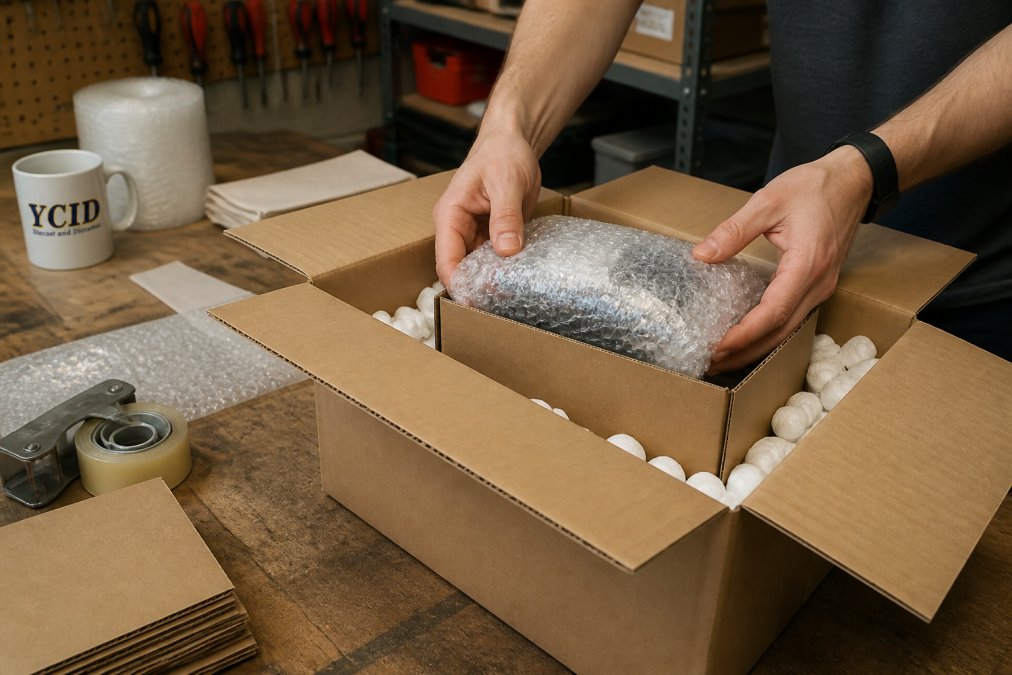
Choose a new double-wall corrugated outer carton when you can, reused boxes lose stacking strength, and a crushed corner is exactly how paint damage happens.
Step 4: Control Moisture and Prevent Corrosion
Moisture control protects the parts that rust, not the parts that chip. Diecast bodies are zinc alloy (Zamak 3 and similar), largely corrosion-resistant, but bases, axles, screws, springs, and some trim are steel or chrome-plated and corrode in humid conditions. The failure mode is not a wet model, it is condensation that forms when a cold box meets warm air, then sits against bare metal for days.
How Much Silica Gel You Actually Need
A 1-gram silica gel packet is sized for roughly one cubic foot of sealed airspace at moderate humidity. A typical 1:18 scale inner box (about 12 x 6 x 5 inches) holds roughly 0.2 cubic feet, so one packet is the floor, not the ceiling. A practical rule:
- Short domestic trip (2-3 days): 1 packet per inner box
- Cross-country ground (5-7 days): 2 packets per inner box
- Any route over a week, or any humid-climate destination: 3-4 packets, or a 5-gram bulk packet
- Multiple models in one outer carton: add packets per inner box, not per outer box
Recharge and Reuse
Most silica gel packets are reusable. When indicator beads turn pink or the packet feels heavy and clumpy, it is saturated: warm the packets on a baking sheet at 200-250°F for two to three hours, then store in an airtight jar. Do not microwave them, they can scorch or ignite.
Temperature Swings and Condensation
- Avoid packing a cold model straight from a garage into a warm box, let it reach room temperature first
- Add a layer of closed-cell foam or a second inner box wall for shipments that will cross climate zones
- Never pack a model that has visible condensation on it; dry it with a microfiber cloth first
Corrosion prevention is a long game: a model that looks fine today can show rust on its axles months later if it traveled damp. For high-value pieces, treat desiccant as insurance, not an optional extra.
Shipping Insurance for Collectible Diecast and Documentation
Shipping insurance for collectible diecast is worth buying whenever the model's replacement value exceeds what you can comfortably lose. Standard carrier coverage is often too low for a limited-run model, so declare the full value and keep documentation.
- Photograph the model before packing
- Photograph each packing layer
- Keep the invoice and declared-value record
- Note any existing flaws before shipping
Eco-Friendly Packing and Cost-Saving Tips
Eco-friendly packing and weight-based cost optimization let you ship safely without overspending or overfilling a landfill. Lighter, right-sized packaging cuts both cost and waste, but only if you understand how carriers bill.
How Dimensional Weight Really Works
Length × Width × Height (inches) ÷ 139 = DIM weight in pounds
- Size the outer box to the inner box plus the void fill, nothing more
- A 1:18 scale model in a proper double-box setup usually fits in a 14 x 10 x 8 inch outer carton
- Consolidating two models into one right-sized box is almost always cheaper than two separate shipments
- Round dimensions down to the nearest inch when you can, every inch counts against DIM weight
Eco-Friendly Fill That Still Protects
For cushioning, replace some plastic void fill with crumpled kraft paper, which is recyclable and curbside-friendly. Paper is heavier than peanuts, so use it where you need structure and keep peanuts or air pillows for bulk fill.
- Crumpled kraft paper: best for wrapping and structural fill around the inner box; heavier but recyclable
- Biodegradable starch peanuts: light, compostable, and dissolve in water, but they compress under load, so use them for bulk fill, not structural support
- Reusable air pillows: lightest option, but they deflate over long transit and should not be the only cushioning layer
- Molded pulp trays: excellent for multi-model shipments and fully recyclable, but add weight and cost
International Shipping: The Gap Most Guides Skip
International routes add three variables domestic guides ignore: customs handling, longer transit times, and temperature swings in cargo holds. An air-freighted model can sit in an unheated hold, then a humid tarmac, then a customs warehouse, three climate cycles in 48 hours.
- Use more silica gel (3-4 packets per inner box) and a stronger double-wall outer carton
- Add a customs declaration and check the destination's import rules before you seal the box
- Photograph the packed box before it leaves, customs inspectors may open it, and you want a record of how it was packed
- Expect longer transit times, which means more vibration cycles; secure every moving part as if the box will be handled twice as many times as a domestic shipment
The Weight-vs-Protection Trade-off
More padding is not always better: every extra layer of bubble wrap and inch of void fill adds weight and DIM volume, raising your cost. The goal is the minimum cushioning that still suspends the model inside a rigid inner box inside a rigid outer box. A properly double-boxed 1:18 model typically ships at 3-5 pounds; if your box weighs 10, you are over-packing.
Frequently Asked Questions
What is the best way to pack a diecast car for shipping?
Wrap the model in acid-free tissue paper first, then bubble wrap, and secure any moving parts with masking tape. Place it in a snug inner box, then put that box inside a larger shipping box with at least 2 inches of void fill on all sides. This double-boxing method absorbs impact and limits movement during transit, which protects both the paint and the structural integrity of the model.
Is bubble wrap safe for diecast car paint?
Bubble wrap is safe when used correctly. The risk comes from direct contact with sharp edges or from tape applied to the model itself. Wrap the model in acid-free tissue paper or a protective sleeve before adding bubble wrap. Use masking tape only on the bubble wrap, never on the paint or decals. This layered approach prevents adhesive residue and paint damage while still providing cushioning.
How do I secure moving parts on a 1:18 scale model?
Use small strips of masking tape or low-tack tape to hold doors, hoods, and trunks closed. For steering wheels or movable suspension parts, wedge a small piece of foam or acid-free tissue paper into the gap. Avoid rubber bands, which can leave marks over time. If the model has a display base, screw or clip it down according to the manufacturer's instructions before packing.
Should I remove the diecast car from its original box before shipping?
Keep the model in its original box whenever possible. Original packaging, including molded trays, is designed to hold the model securely and protect delicate parts. If the original box is damaged or missing, use a custom packing method with acid-free tissue paper, bubble wrap, and a snug inner box. The original box also preserves collector value, so it is worth including even if you add extra outer protection.