Rare 1970 Dodge Challenger Diecast Models: Top Picks
Table of Contents
- Why Rare 1970 Dodge Challenger Diecast Models Hold Their Value
- Top Rare 1970 Dodge Challenger Diecast Models to Collect
- 1970 Dodge Challenger R/T 1:18 Diecast: Details That Matter
- 1970 Dodge Challenger T/A Diecast Model: What to Look For
- 1:18 vs 1:24 Diecast Scale: Which Size Fits Your Collection
- How to Spot Authentic vs Counterfeit Challenger Diecast Models
- Conclusion: Building a Focused Challenger Diecast Collection
- Frequently Asked Questions
Last Updated: October 12, 2026
Why Rare 1970 Dodge Challenger Diecast Models Hold Their Value
The most reliable signal that a rare 1970 Dodge Challenger diecast model will hold its value is a documented production cap, not the paint color. Every YCID release is built around a fixed run size, so a model capped at 48 units is always scarcer than one capped at 199.
When a run closes, it never reopens.
Limited Production Numbers and Certificates of Authenticity
A certificate of authenticity is only as good as the number printed on it. Every YCID Challenger ships with a COA that ties the car to its run, and caps vary sharply by body style: a coupe run of 199 is common, a convertible run of 48 is not.
That gap explains why convertibles in the same release often carry the highest asking prices: collectors chasing a complete set need the smallest number last.
Top Rare 1970 Dodge Challenger Diecast Models to Collect
Three YCID releases anchor most serious Challenger collections: the YCID 44 383 Shaker for anyone who wants an in-stock car today, the YCID #31 440 Magnum coupe for color-driven buyers, and the YCID 45b tribute editions for collectors who plan ahead.

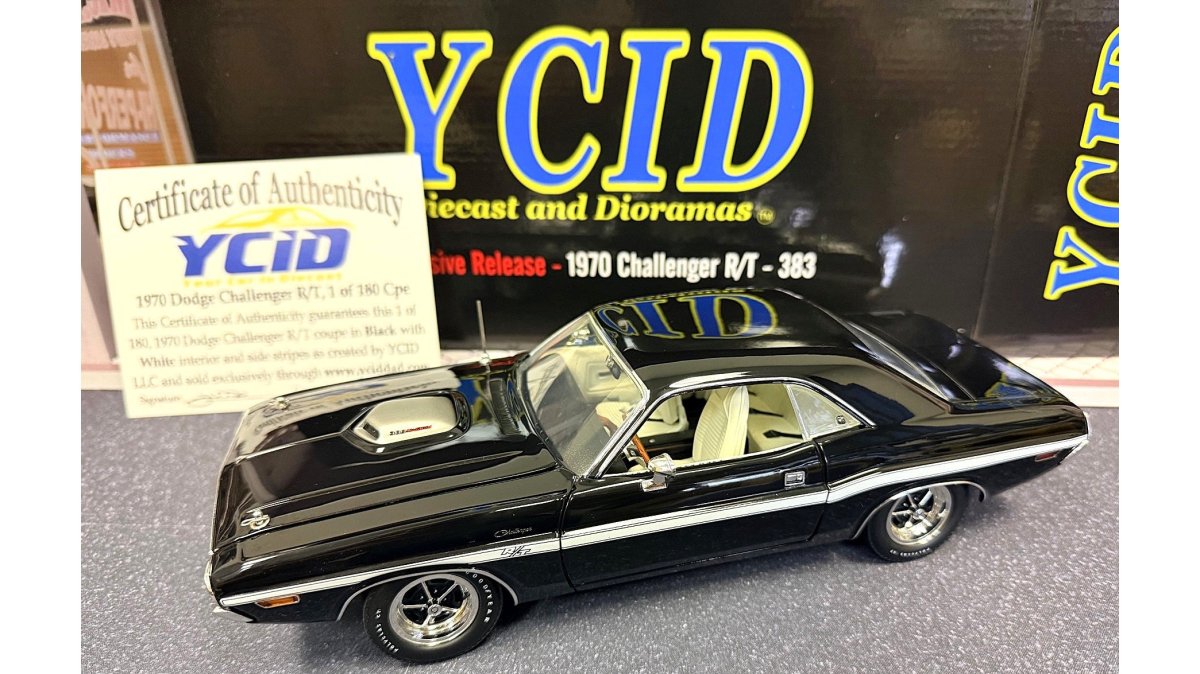
YCID 44: 1970 Dodge Challenger R/T 383 Shaker
The YCID 44 is our most accessible rare Challenger diecast model, and the one we recommend to collectors who want a car in hand this week. It comes in Black with a White interior and side stripes, built as a 383 four-speed car with Magnum 500 road wheels and a COA.
Run sizes step down as the body style gets more complex:
| Body Style | Run Size | Price |
|---|---|---|
| Coupe | 199 | $144.95 |
| Vinyl Top | 72 | $154.95 |
| Convertible | 48 | $195.95 |
The convertible is the one to watch. Only 48 exist, and that number will not grow. These are in stock and ready to ship.
YCID #31: 1970 Dodge Challenger R/T 440 Magnum
The YCID #31 pairs a Silver body with a Red interior and Red R/T stripe, based on an export Challenger from 1970. Magnum 500 wheels finish the car, and each arrives in an art deco box with a COA.

Two body styles exist: the coupe is capped at 150 units for $139.95, and the convertible at 72 units for $186.95 with a red boot.
YCID 45b: Vanishing Point Tribute Editions
The YCID 45b is the same car as our Vanishing Point Tribute release, distinguished by a Black R/T side stripe. All three variations carry a Black interior with White houndstooth and YCID LE license plates, and each ships in the original desert scene box with a COA.

- 12 Coupes with Black R/T stripe: $149.95
- 24 Convertibles with Black stripe and boot: $194.95
- 36 Vinyl tops with factory-applied Black stripe: $159.95
Twelve coupes is the tightest run we have published. These are open for pre-order at $10.00 with the balance due when invoiced, and should be ready before year end. Sunroof versions have their own listing.
1970 Dodge Challenger R/T 1:18 Diecast: Details That Matter
Paint accuracy is the first thing collectors inspect on a 1970 Dodge Challenger R/T 1:18 diecast, and the fastest way to separate a serious release from a toy. The Black on the YCID 44 is deep and even, with White side stripes laid straight along the body line, and the Silver on the YCID #31 carries the Red R/T stripe without bleeding at the edges.
Look at the small parts next. Magnum 500 wheels should read as road wheels, not generic discs, and the interior should match the body's story, the YCID 44 pairs Black paint with a White interior, the YCID #31 pairs Silver with Red.
Body detail matters just as much. Panel gaps on a well-built 1:18 scale replica stay consistent down the doors and around the trunk, and the factory-applied vinyl top on the YCID 44 and the 45b should sit flush rather than floating above the roofline.
1970 Dodge Challenger T/A Diecast Model: What to Look For
A 1970 Dodge Challenger T/A diecast model should be judged on how faithfully it captures the T/A's identity, not on how many features it lists.
Start with the stance and stripe package, then check the wheels against the car's intended use, since race-bred and street versions do not share the same look.
The same discipline applies to Pro Stock and drag racing versions: a faithful replica should carry that aggression in the ride height and wheel choice, and if a race version looks identical to a street coupe, something is off.
Identifying a T/A Release by Its Details
Most 1:18 T/A replicas share a common checklist. Work down it in order:
- Side stripe and hood treatment. The T/A carries a distinctive side stripe and a matte-black hood treatment the R/T does not. On a faithful replica the stripe terminates cleanly at the front fender, and the hood finish reads flat rather than glossy.
- Spoiler package. Front and rear spoilers are part of the T/A silhouette. On a good model they sit at the correct angle and are molded as separate pieces, not painted onto the body.
- Wheel type. T/As left the line on Rallye-style road wheels. A release shipping with Magnum 500s is either an R/T casting or a variant that swapped wheels, a distinction that matters when completing a set.
T/A vs R/T vs Pro Stock: What Separates Them on the Shelf
Collectors who mix these three on one shelf lose the contrast that makes each one interesting. The table below summarizes the visual cues that separate them:
| Feature | T/A Replica | R/T Replica | Pro Stock Replica |
|---|---|---|---|
| Stance | Slightly lowered, race-bred | Stock ride height | Aggressive, nose-down |
| Hood | Matte-black treatment | Body-color or Shaker | Tall scoop or cowl |
| Wheels | Rallye-style road wheels | Magnum 500 road wheels | Wide racing slicks |
| Stripe | T/A side stripe | R/T stripe | Sponsor-style graphics |
| Interior | Black, patterned seats | Body-matched color combos | Gutted, race-style |
If a listing claims a T/A but shows Magnum 500 wheels and a body-color hood, treat it as an R/T casting with T/A badging, the most common mislabeling pattern in secondhand listings.
Where T/A Replicas Fit in a Collection
A T/A replica earns its place as the race-bred counterpart to the R/T cars already on your shelf. Because T/A castings are produced in smaller numbers than standard R/T runs, they sell through faster and appear less often on the secondary market, so if you see one in the color and body style you want, buy it when it is available rather than wait for a restock that may not come.
YCID 44, 1970 Dodge Challenger R/T, 383 Shaker →
Our finished 1:18 Challenger releases, including the R/T cars that pair with a T/A on the shelf, are ready to display out of the box. Browse the current Challenger lineup to see which body styles and color combinations are in stock.
1:18 vs 1:24 Diecast Scale: Which Size Fits Your Collection
Scale is a display decision, not a quality decision. A 1:18 scale replica is the collector standard for American muscle cars, and it is the size we build our Challenger releases in.
Here is how the two sizes differ in practice:
| Factor | 1:18 Scale | 1:24 Scale |
|---|---|---|
| Shelf footprint | Large, one car per display slot | Compact, several cars per shelf |
| Detail visibility | Engine, interior, and trim read clearly | Smaller details compress |
| Best for | Feature displays and dioramas | Dense, space-limited collections |
If your collection is the centerpiece of a room, stay with 1:18. If you want forty cars on one wall, 1:24 lets you do it. Our display dioramas are built in 1:18, 1:24, and 1:64 scales, so the environment can match whichever size you commit to.
Scale-by-Scale Buying Guidance
Most collectors who regret a purchase regret the scale, not the model. The three scales below cover nearly every 1970 Challenger replica on the market, and each rewards a different kind of buyer.
1:18 scale. This is the collector standard.
1:64 scale. A 1:64 Challenger replica is roughly 3 inches long, small enough that a dozen fit on a single shelf.
Matching Scale to Display Space
A practical way to decide is to measure the shelf first and pick the scale second. As a rough guide, a 36-inch shelf holds one 1:18 car with room for a diorama, three to four 1:24 cars, or a full row of 1:64 cars. If you want the Challenger as the focal point, 1:18 supports that; if you want it to be one of many, 1:24 or 1:64 lets you build the lineup without running out of shelf.
Our finished 1:18 Challenger releases and matching display dioramas in 1:18, 1:24, and 1:64 scales are ready to display out of the box. Browse the Challenger collection to see which scales and body styles are in stock.
How to Spot Authentic vs Counterfeit Challenger Diecast Models
The most reliable authenticity check on a Challenger diecast model is the paperwork, not the car.
Check the packaging next. Our cars ship in branded boxes, including the art deco box on the YCID #31 and the desert scene box on the 45b.
Then inspect the car itself for details that are expensive to fake:
- Correct wheel type for the release, such as Magnum 500 road wheels
- Interior color that matches the documented combination
- Crisp stripe edges with no bleed into the paint
One more check: ask whether the model is in stock or on pre-order. A seller who cannot tell you the difference is not tracking the release closely.
Conclusion: Building a Focused Challenger Diecast Collection
Rarity in this hobby is a paper trail, not a paint job. A Challenger diecast model is only as collectible as its documented run size, and cars capped at 12, 24, and 48 units will always be harder to complete a set around than those capped at 150 or 199.
That is how we build every release at YCID Diecast and Dioramas: fixed production numbers, a COA in every box, and body styles that step down in quantity as they get more complex. Our 1:18 scale Challengers and matching display dioramas in 1:18, 1:24, and 1:64 scales are made for collectors who want a finished car on the shelf, not a project.
Start with the run size that matches how you collect, and add the convertible while it is still available.
Frequently Asked Questions
Which 1970 Dodge Challenger diecast model is hardest to find?
The YCID 44 383 Shaker convertible, limited to 48 units, is among the hardest to find due to its small production run. The vinyl top version, capped at 72 units, is also scarce. Both come with certificates of authenticity and Magnum 500 wheels, making them highly sought after by collectors who prioritize low production numbers and verified documentation.
What makes a 1970 Dodge Challenger diecast model collectible?
Limited production runs, certificates of authenticity, and accurate trim details like the R/T stripe, Magnum 500 wheels, and correct engine callouts drive collectibility. YCID models, for example, cap runs between 12 and 199 units depending on body style. Condition, original packaging, and completeness of the COA also affect long-term collector interest and resale potential.
How do 1:18 and 1:24 scale Challenger diecast models compare?
1:18 scale models are roughly 10 to 11 inches long and offer more detail in the engine bay, interior, and paint finish. 1:24 scale models are about 7 to 8 inches long, take up less shelf space, and cost less. Collectors who want maximum detail and display presence typically choose 1:18, while 1:24 suits tighter display areas or larger collections.
Are 1:18 scale 1970 Dodge Challenger models suitable for display?
Yes. Their size and detail make them ideal for shelf or cabinet display, especially when paired with a finished diorama. YCID offers pre-built dioramas in 1:18, 1:24, and 1:64 scales, so collectors can create a cohesive scene without any assembly. Free US shipping applies to in-stock orders over $300.
How can you compare 1970 Dodge Challenger diecast models?
Compare production numbers, body style (coupe, convertible, vinyl top), trim (R/T vs T/A), scale, and included documentation like a COA. Price is another factor: YCID coupes start at $139.95, convertibles at $186.95, and vinyl tops at $154.95. Lower production counts and verified authenticity generally indicate higher collectibility.