1:18 Scale Muscle Car Display Ideas for Collectors
Table of Contents
- Why 1:18 Scale Muscle Cars Deserve a Proper Display
- Best Display Cases for 1:18 Cars: Acrylic, Glass, and Wall-Mounted Options
- 1:18 Scale Diorama Accessories That Bring the Scene to Life
- DIY Diecast Car Display Ideas for Budget-Conscious Collectors
- Preserving Your Collection: UV Protection, Dust Control, and Seismic Proofing
- Themed Diorama Setups and Displaying With Original Packaging
- Conclusion
- Frequently Asked Questions
Last Updated: September 20, 2026
Why 1:18 Scale Muscle Cars Deserve a Proper Display
A 1:18 scale muscle car is a scaled-down piece of American automotive history, and how you display it determines whether it reads as a toy or a genuine collector's piece. At YCID Diecast and Dioramas, we build and sell display environments for exactly this reason: the right case, lighting, and shelf arrangement change how a muscle car display is perceived.
Best Display Cases for 1:18 Cars: Acrylic, Glass, and Wall-Mounted Options
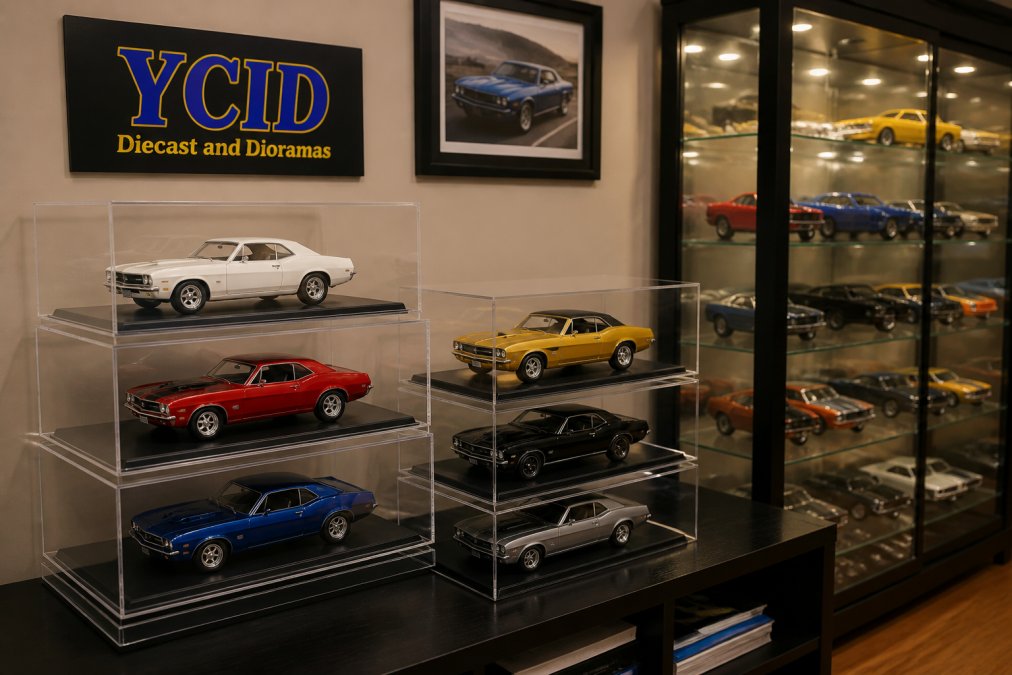
The best display case for a 1:18 car is one that keeps dust off the model, blocks direct sunlight, and lets you see the car from multiple angles. Acrylic cases win on clarity and price, glass-fronted cabinets win on protection, and wall-mounted units win on floor space.
Acrylic Display Stands and Risers
Acrylic display stands and risers are the fastest way to lift a 1:18 model off a flat shelf and give it presence. Clear risers create a tiered effect so a row of muscle cars does not read as a parking lot. A common mistake is buying a riser sized for 1:24 or 1:64 models; a 1:18 car needs a base plate at least 30 cm deep to sit without overhang.
Glass-Fronted Display Cases and Wall-Mounted Cabinets
Glass-fronted display cases and wall-mounted cabinets offer the strongest dust protection and the cleanest visual impact. A wall-mounted cabinet frees up floor and shelf space, which matters once a collection grows past a dozen cars. Look for adjustable shelf spacing, since 1:18 models with open hoods or raised antennas need extra vertical clearance.
| Display Option | Dust Protection | Best For | Space Used |
|---|---|---|---|
| Acrylic case | Good | Single featured cars | Shelf top |
| Glass-fronted cabinet | Excellent | Larger collections | Floor or wall |
| Wall-mounted cabinet | Excellent | Small rooms | Wall only |
| Open shelf with risers | Low | Rotating displays | Shelf top |
1:18 Scale Diorama Accessories That Bring the Scene to Life
Diorama accessories turn a display into a story. A 1:18 scale diorama accessory set typically includes base plates, risers, printed wall graphics, and lighting, all scaled to match the model. YCID Diecast and Dioramas builds ready-to-assemble showroom and garage dioramas in 1:18, 1:24, and 1:64 scale, including the Mr. Norms Grand Spaulding Dodge Showroom Diorama ($249.95 in 1:18), with ceiling lights, a slide-out front panel, and licensed period signage.

Lighting Temperature and LED Solutions for Diecast
LED lighting is the single biggest upgrade to any diecast display, and temperature matters more than brightness. Warm white strips in the 3000K-4000K range flatter muscle car paint; cool blue lighting above 6000K washes out deep reds and oranges. Keep lights on the ceiling of the case or diorama rather than aimed directly at the paint.
Base Plates, Risers, and Custom Shelving
Base plates and custom shelving handle the structural side. A sturdy base plate protects the model's tires and undercarriage, while custom shelving lets you match shelf depth to your longest model. Leave at least 5 cm of headroom above each car so raised hoods clear the shelf above.
DIY Diecast Car Display Ideas for Budget-Conscious Collectors
Most display guides split into two camps: cheap shelves with no protection, or custom millwork that costs more than the cars. The middle ground, a hardware-store build that actually protects the paint, is where most collectors should live.
The $60-to-$150 Bookshelf Conversion
Start with a standard flat-packed bookcase and treat it as a shell, not a finished display. Three upgrades do most of the work:
- Back panel. Replace or cover the thin fiberboard back with a matte black or charcoal hardboard panel. Matte black absorbs stray light and makes model paint read as the brightest surface in the case. Glossy backings create hot spots that wash out metallic flake.
- Shelf edging. Add a thin strip of adhesive-backed foam weatherstripping along the front edge of each shelf. It stops models from sliding forward when the shelf is bumped and hides the raw particleboard edge.
- Door or front panel. A sheet of 1/8-inch clear acrylic cut to the opening, held with magnetic cabinet catches, turns an open shelf into a dust-controlled case for well under the cost of a glass-fronted cabinet. Acrylic scratches, so clean it with a microfiber cloth and plastic polish, never paper towels.
Shelf Spacing and Load Numbers That Matter
A 1:18 model runs roughly 25-28 cm long and weighs 1 to 2 pounds depending on whether it is diecast or resin. That weight matters: a standard 3/4-inch particleboard shelf on pin supports will sag under a full row of diecast. Two fixes:
- Add a center support or a 1x2-inch hardwood stiffener screwed to the underside of any shelf longer than about 30 inches.
- Keep heavy diecast on lower shelves and lighter resin or sealed models up top. This also lowers the center of gravity of the whole unit, which matters for the seismic reasons below.
Lighting on a Budget
A warm white LED strip (3000K-4000K, 90+ CRI) adhered to the underside of the shelf above, run through an inline dimmer, gives the same flattering effect as a built-in case light for a fraction of the cost. Avoid cool white or "daylight" strips above 6000K; they push deep reds and oranges toward brown and make chrome look blue.
The UV and Stability Upgrades Nobody Mentions
Two cheap additions separate a DIY build from a professional one:
- UV-filtering film. Adhesive window film rated to block UV (commonly sold in rolls at hardware and home stores) applied to acrylic door panels or glass shelves cuts the ultraviolet load that fades paint and yellows clearcoat. It is the single highest-value upgrade for a display that sits anywhere near a window.
- Museum putty or clear gel tabs. A small dab under each tire keeps models from creeping forward on a sloped or vibrating shelf and adds meaningful resistance during a seismic event. Pair it with L-brackets into wall studs if the unit is tall or top-heavy.
Preserving Your Collection: UV Protection, Dust Control, and Seismic Proofing
Preservation separates a collection that holds value from one that fades. UV protection, dust control, and seismic proofing each solve a different threat, and all three are cheap compared to repainting a damaged model.
Mr Norms Grand Spaulding Dodge Showroom →
Themed Diorama Setups and Displaying With Original Packaging
Themed diorama setups group cars by era, brand, or story rather than by whatever fits on the shelf. A dealership showroom, a 1960s speed shop, or a two-car garage scene each give a muscle car display a reason to exist beyond storage. YCID Diecast and Dioramas offers several themed options, including the Yenko Chevrolet Dealership Diorama ($239.95 in 1:18), modeled on the Don Yenko dealership in Cannonsburg, PA, and Crankys Speed Shop ($114.95), a fictional 1960s-80s speed shop with a four-stall parking lot.

Three Themed Frameworks That Actually Work
Rather than collecting dioramas at random, pick a framework and let it drive what you buy next:
- The dealership. Group cars that would have shared a showroom floor in the same model year, with period signage and a tile or linoleum floor graphic. This framework rewards accuracy: wrong-year signage breaks the illusion faster than a wrong car does.
- The speed shop. A working garage scene with a lift, tool chests, and a parking apron. This is the most flexible framework because it justifies mixing eras and brands, the way a real speed shop would have.
- The personal garage. A two- or three-car residential garage with a workbench and pegboard. This is the cheapest framework to build and the easiest to expand one car at a time.
Displaying With Original Packaging: The Collector's Real Dilemma
Boxes matter to value, especially for sealed or limited-run models, but a wall of boxes is not a display. The collectors who handle this best use one of three approaches:
- Box stored, car displayed. Flatten or store the box in a climate-controlled spot (not an attic or garage, where heat and humidity degrade both the cardboard and any foam inserts). Photograph the box, the end label, and the model number for your records. This preserves resale documentation without sacrificing the display.
- Car displayed in front of its box. A shelf deep enough for the box (typically 12-14 inches for a 1:18 box) lets the packaging act as a backdrop. This works well for a single hero car and reads as intentional rather than cluttered.
- Box displayed separately. A dedicated "box wall" on a high shelf or in a closet keeps packaging visible and accessible without competing with the cars for prime display space.
Matching the Diorama to the Model
Scale accuracy matters more than most collectors realize. A 1:18 diorama accessory set is built to 1:18 proportions, so a 1:24 or 1:64 model placed inside it will look wrong even to someone who cannot articulate why. Keep scales consistent within a scene, and if you mix scales on one shelf, separate them with a visual break such as a wall graphic or a change in riser height.
A themed display works when the environment, the cars, and the packaging all tell the same story. Pick one framework, keep the scale consistent, and treat the original box as part of the collection rather than something to hide.
Conclusion
Building a display that does justice to a 1:18 scale collection takes more thought than most collectors expect, and the details, lighting temperature, UV protection, shelf spacing, separate a showcase from a shelf. YCID Diecast and Dioramas builds ready-to-assemble dioramas in 1:18, 1:24, and 1:64 scale with working ceiling lights, slide-out front panels for easy model swaps, and licensed period signage, plus free US shipping on in-stock models over $300.
Frequently Asked Questions
How should I display 1:18 scale model cars without damaging them?
Keep models out of direct sunlight and away from heat sources to prevent paint fading and warping. Use a dust-proof case or cabinet with a front panel to limit dust buildup, and handle cars by the body rather than the wheels or mirrors. Rotate models periodically if they sit on the same shelf for months, and avoid stacking heavy items on top of display cases. A stable shelf arrangement with proper spacing prevents accidental contact between models.
What are the best display cases for 1:18 cars?
Acrylic cases offer clarity and lighter weight, while glass-fronted cabinets provide a more furniture-style look and better scratch resistance. Wall-mounted display cabinets save floor space and keep models at eye level. For collectors with larger collections, modular shelving with adjustable spacing works well because you can set shelf heights to fit taller models. Look for cases with sealed edges or front panels to reduce dust, and check that interior dimensions match your model's length and height.
What lighting temperature works best for diecast car displays?
LED strip lights and small ceiling fixtures, like the ones included with several YCID dioramas, run cool and draw little power. A USB-to-wall adapter for these lights costs about $5.00 at most drugstores or big-box retailers.
How do I protect 1:18 scale muscle cars from dust and UV damage?
Dust protection starts with an enclosed case or a diorama that has a slide-out front panel, which keeps models 99% dust free as noted in YCID's garage diorama listing. For UV protection, position displays away from windows and use cases with UV-filtering acrylic or glass. If your display area gets indirect sunlight, consider adding a UV film to nearby windows. Regular gentle dusting with a soft brush removes surface particles before they bond to paint or decals.
Can I use 1:18 scale diorama accessories with models from different brands?
Yes. Most 1:18 scale diorama accessories and display environments are built to standard scale dimensions, so they work with models from various manufacturers. YCID's Universal 3 Level Dealership and Universal 2 Car Garage are designed as universal displays rather than brand-specific setups. The main thing to check is that your model's length and height fit the diorama's interior footprint. The Universal 3 Level Dealership floors hold 3 to 4 models each, and the 2 Car Garage measures 15.5 by 14.5 by 8 inches.
What are some DIY diecast car display ideas for a small space?
Wall-mounted shelves, shadow boxes, and repurposed bookcases with added LED strip lighting are practical starting points. You can build tiered risers from foam board or wood scraps and cover them with felt to prevent scratches. A basic cabinet transformation with a slide-out acrylic front panel adds dust protection without a full custom build. For collectors who want a themed look, printing a garage or showroom backdrop and mounting it behind the shelf creates a diorama feel at low cost.
How can I incorporate dioramas into my 1:18 scale car display?
Start with a single diorama that matches your collection's theme, such as a dealership showroom or a speed shop scene. YCID offers pre-built and easy-to-assemble dioramas like the Mr. Norms Grand Spaulding Dodge Showroom at $249.95 for the 1:18 scale version, which includes ceiling lights and a slide-out front panel for swapping models. Place the diorama at eye level and use it as the centerpiece, then arrange standalone models on nearby shelves to extend the scene.
Are wall-mounted display cabinets a good option for heavy diecast collections?
Wall-mounted cabinets work well if they are anchored into wall studs or use heavy-duty toggle bolts rated for the combined weight of the cabinet and models. A single 1:18 scale diecast model can weigh 2 to 4 pounds, so a cabinet holding 10 models needs hardware rated for at least 40 pounds plus the cabinet's own weight. Check that shelves are thick enough to resist bowing over time. For earthquake-prone areas, add shelf lips or museum putty to keep models from sliding off during tremors.