How to Verify Limited Edition Diecast Models
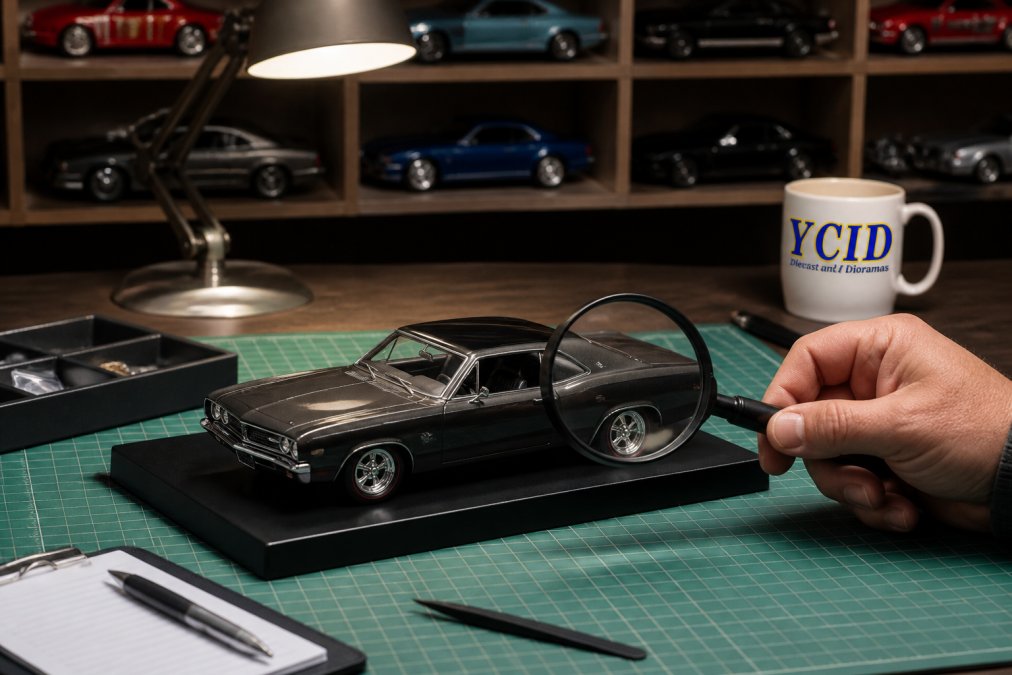
Table of Contents
- What You'll Need Before You Start Verifying
- How to Check a Diecast Certificate of Authenticity
- Diecast Serial Number Verification: Matching Numbers to Production Runs
- How to Spot Fake Diecast Cars: Chassis, Base, and Molded Markings
- Inspecting Paint, Packaging, and Scale Markings on Limited Edition Diecast
- Advanced Verification: Material Weight, Digital Tools, and Provenance
- Common Mistakes When Verifying Limited Edition Diecast
- Conclusion
- Frequently Asked Questions
Last Updated: September 12, 2026
What You'll Need Before You Start Verifying
Verifying a limited edition diecast means checking what you have against what the manufacturer says should exist. Your basic kit:
- A bright, adjustable desk lamp or a phone flashlight
- A magnifying loupe (10x is enough) or your phone's macro lens
- A soft microfiber cloth and a clean, well-lit surface
- The seller's listing photos, saved for side-by-side comparison
- A small kitchen scale, ideally accurate to 1 gram
- Paperwork: any certificate of authenticity, box, and receipt
At YCID Diecast and Dioramas, we build every release with its own numbered COA and special box decals, so we know what a legitimate paper trail looks like. A limited edition diecast is only as verifiable as its documents and markings.

How to Check a Diecast Certificate of Authenticity
A diecast certificate of authenticity ties a model to a production run through a serial number, release name, and manufacturer branding. If it is missing, generic, or easily photocopied, treat the model as unverified until physical markings confirm it. Legitimate certificates are printed, not photocopied, with consistent typography, clean edges, and often a holographic or embossed element. Look for:
- A serial number that matches a marking somewhere on the model or base
- The exact release name and scale, spelled the same way as on the box
- A production quantity stated in plain numbers
- Print quality that holds up under magnification, with no pixelation or blur
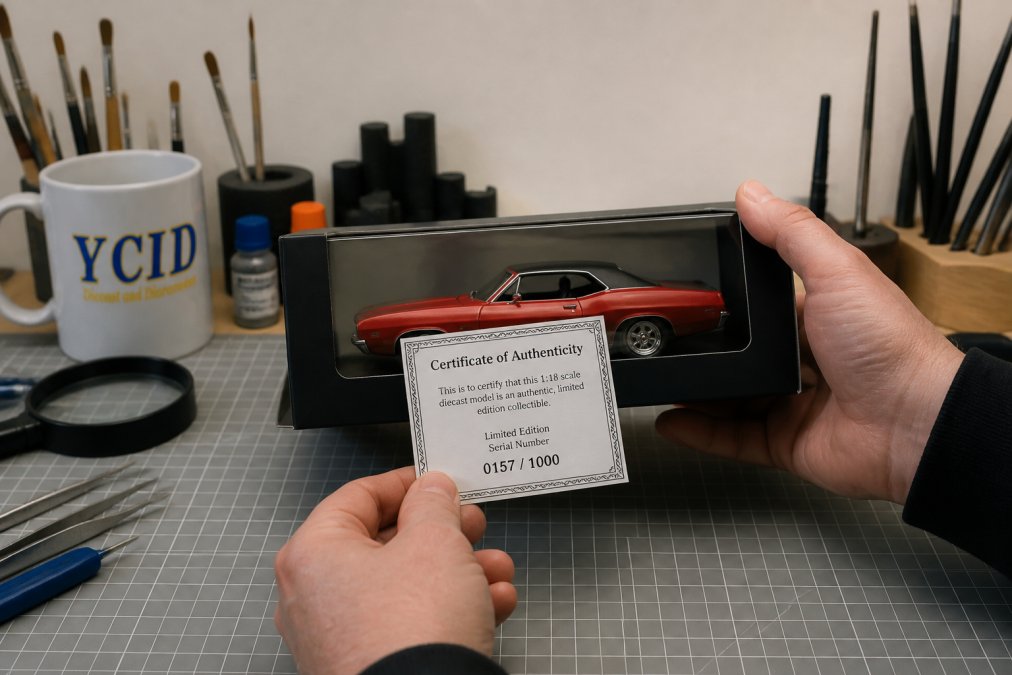
Counterfeiters reproduce paperwork far more easily than tooling, so a COA is a starting point, not a conclusion. Cross-check it against the model.
For context on how documentation standards work in collectible markets, the Federal Trade Commission guidance on deceptive advertising is worth reading, since misrepresenting a product's origin or rarity is a legal issue, not just an etiquette one.
Diecast Serial Number Verification: Matching Numbers to Production Runs
Diecast serial number verification means confirming the number on your certificate, box, and model base all refer to the same unit within a stated production run. Three matching numbers is a strong signal; a mismatch is a red flag.
Work through the chain in order:
- Read the serial number on the COA and write it down.
- Find the corresponding marking on the model base or chassis.
- Check the box label or decal for the same number or run identifier.
- Confirm the number falls within the stated production quantity.
If a release is limited to 199 units, a serial reading 214 is impossible. That check alone eliminates many fakes, since counterfeiters reuse a small pool of numbers.
How to Spot Fake Diecast Cars: Chassis, Base, and Molded Markings
The fastest way to spot fake diecast cars is to flip the model over. Molded chassis and base markings are expensive to reproduce, so counterfeiters get them wrong: soft lettering, wrong scale callouts, missing licensing text, or a base that does not match the car's era.
Inspect these areas under good light:
- Molded markings: manufacturer name, scale, and country of origin should be crisp and correctly spelled
- Base plate fit: genuine bases sit flush; fakes often show gaps or excess flash
- Chassis detail: panel lines, suspension hints, and exhaust routing should match reference photos
- Fasteners: screws and rivets should be consistent in size and finish
Macro-Level Defect Identification
The real edge is knowing what to look for at magnification, because factory tooling and amateur reproduction leave different fingerprints. A 10x loupe or phone macro lens separates them. Check these at magnification:
- Lettering edges: genuine molded text has crisp, vertical sidewalls where tool steel met the die. Counterfeit text, especially on resin or 3D-printed bases, shows rounded or "melted" edges because it was reproduced from a cast or scan rather than cut into steel.
- Ejector pin marks: real die-cast tooling leaves small circular ejector pin marks on hidden base surfaces. Their absence where they should appear, or presence in the wrong location, is a strong tell.
- Parting lines: genuine castings have one consistent parting line where the mold halves met. Fakes show doubled, wandering, or sanded-away lines.
- Sprue and flash: excess flash around mirrors, grilles, and exhaust tips usually means a low-pressure or gravity cast rather than the high-pressure die casting used on genuine limited runs.
- Surface texture: high-pressure die casting produces a fine, uniform grain; sand and resin casting produce a coarser, irregular surface obvious under magnification.
Material Weight Analysis
Weight is one of the hardest things for a counterfeiter to fake. Genuine die-cast metal has a characteristic heft from zinc alloy (zamak). Counterfeits substitute cheaper alloy, hollow out the casting, or use resin or plastic where metal belongs.
Use a kitchen scale accurate to 1 gram and compare your model to a known genuine example:
- Weigh the model with the base and any removable parts in place, and note the reading.
- Weigh a confirmed genuine example of the same casting and scale.
- A difference of more than a few grams on a 1/18 scale car usually signals a different material mix or a hollowed casting.
- A model that feels suspiciously light for its size is the single most common red flag reported by collectors.
Combine the weight reading with a photo of the base, and you have a defensible record that stands up in a dispute.
Cross-Checking Against Reference Photos
Build a reference library before you buy: photograph the base, chassis, and molded markings on models you own, and save manufacturer catalog images for the casting you are evaluating. If a listing photo shows a base that does not match your reference, wrong font, missing licensing text, wrong scale format, treat it as unverified until you inspect the physical model.
Inspecting Paint, Packaging, and Scale Markings on Limited Edition Diecast
Paintwork and packaging separate serious limited edition diecast from mass-produced imitations. Factory paint on a genuine limited run is even, with clean masking lines and no overspray. Counterfeit paint is thicker, glossier, or uneven at panel gaps.
Check the finish against these markers:
- Masking lines between two-tone stripes are sharp, not feathered
- Decals and stripes sit flat, with no silvering or lifting edges
- Clear coat is consistent across the body, not patchy
- Scale markings (1/18, 1/24, 1/64) appear in the correct format and match the box
Packaging carries equal weight. Original boxes with correct labeling, inserts, and tamper-evident seals protect value and confirm provenance. A loose model with a reprinted box loses both.
Macro-Photography for Paint Authentication
A phone macro lens or 10x loupe turns a subjective "looks off" into a documented, comparable defect. A repeatable method:
- Set up a single, diffuse light source at a low angle to the body. Raking light reveals orange peel, runs, and dust nibs that flat lighting hides.
- Photograph the same panel on your model and on a known genuine example at the same magnification and distance.
- Compare four things side by side: orange peel texture, masking line sharpness, decal edge silvering, and clear coat depth.
- Save both images with the same filename convention so you can pull them up in a dispute.
What you are looking for at magnification:
- Factory paint shows a fine, uniform orange peel that is consistent panel to panel, with masking lines cut cleanly against the body.
- Amateur repaints show heavier orange peel, sanding scratches under the clear coat, overspray on glass or trim, and masking lines that feather or bleed.
- Decals on genuine models sit flat with no silvering; aftermarket decals often show a visible carrier film edge or lift at the corners.
Digital Verification Tools
Digital checks catch problems no loupe will reveal:
- Reverse image search: run the seller's photos through a reverse image search. If the same photos appear on multiple listings, in a catalog, or on a stock photo site, the seller is not photographing the actual unit.
- Manufacturer databases and registries: many manufacturers publish production run information, serial ranges, and release archives online. Cross-check the stated quantity and serial range against the manufacturer's records, not the listing.
- QR and barcode scanning: some modern releases embed a QR code or barcode on the COA or box that links to a manufacturer verification page. Scan it and confirm the serial number it returns matches the physical markings on the model.
- Seller history: review the seller's feedback and past listings for patterns, repeated "limited edition" claims, stock-only photos, or a history of returns.
- Collector forums and registry threads: search the casting name and serial number in collector communities. Owners maintain running lists of known serial ranges and can flag numbers outside the legitimate run.
Secondary Market Provenance When the COA Is Missing
A missing certificate does not automatically mean a fake, but you must rebuild the paper trail yourself:
- Original receipt or invoice: even a photographed receipt ties the model to a purchase date and seller.
- Chain of ownership: ask the seller for names or handles of prior owners. A documented chain beats a vague "bought it years ago."
- Auction and forum records: completed auction listings and forum sale threads often preserve photos and serial numbers that confirm a model's history.
- Manufacturer confirmation: if the manufacturer still operates, a direct inquiry with the serial number and photos can sometimes confirm whether the unit is genuine.
- Consistency check: the model's condition, paint, and markings should be consistent with the claimed history. A "stored since new" model with heavy play wear is a contradiction.
When the COA is gone, provenance is the substitute. A model with a documented chain of ownership and consistent condition is far more verifiable than one with a perfect-looking certificate and no history.
Advanced Verification: Material Weight, Digital Tools, and Provenance
Material weight analysis and provenance research are the angles most collectors skip, and often the most decisive. A suspiciously light model may use cheaper alloy or plastic where metal belongs.
Weigh the model and compare it to a known example of the same casting; a difference of more than a few grams on a 1/18 scale car usually means a different material mix. Combine the reading with a photo of the base for a defensible record.
Digital verification tools are catching up fast. Reverse image searches surface reused stock photos, seller history checks reveal patterns, and collector forums let you compare serial ranges. Macro-photography helps too: shoot the base markings, COA, and box label at high magnification and compare them against reference images.
Secondary market provenance rounds out the picture. A documented chain of ownership, original receipts, and consistent seller history carry real weight. As the U.S. Copyright Office overview of licensing and reproduction explains, authorized reproduction requires permission, which is exactly why unlicensed "limited" runs tend to fall apart under scrutiny.
Common Mistakes When Verifying Limited Edition Diecast
The most common mistakes when verifying limited edition diecast come from checking one thing and stopping. Authentication is cumulative; one convincing detail rarely proves anything.
Watch for these errors:
- Trusting a COA without matching it to the model's markings
- Ignoring box condition and labeling because the car "looks right"
- Skipping the scale markings, which are easy to misprint
- Assuming rarity from marketing language rather than a stated production quantity
- Failing to photograph evidence before contacting the seller
A practical safeguard is a verification record for every purchase: photos of the box, COA, base markings, and a weight reading. It takes five minutes and protects your collection and resale value.
Conclusion
Verifying a limited edition diecast takes patience but rewards you with confidence and preserved value. Work the chain every time: certificate, serial number, chassis markings, paint, packaging, and provenance.
At YCID Diecast and Dioramas, every release ships with its own numbered COA and special box decals, and our 1:18, 1:24, and 1:64 scale models and dioramas are built for collectors who care about authenticity. Browse our in-stock models and take advantage of free shipping on orders over $300. Get started with YCID Diecast and Dioramas and add a verified piece to your display.
Frequently Asked Questions
Do all limited edition diecast models come with a certificate of authenticity?
Not always. Many limited edition diecast models include a COA, but some smaller runs or older releases do not. If a COA is missing, check the chassis for serial numbers and molded markings, and look for tamper-evident packaging. For models like YCID's 1970 Cuda releases, a numbered COA is standard. Without documentation, verify the model through production run records and collector forums before assuming authenticity.
How can I tell if a diecast model is a counterfeit?
Counterfeit diecast cars often have poor paintwork, misaligned doors, and fuzzy printing on the base. Check the chassis for correct licensing text and scale markings like 1/18 or 1/64. A genuine limited edition diecast will have a matching serial number on the COA and the model base. If the packaging feels flimsy or the branding looks off, treat it as suspect and compare with known authentic examples.
Are limited edition diecast cars always numbered?
Most limited edition diecast cars are numbered, but not all. Numbering is common for runs under 500 units, especially for collector-focused brands. Some manufacturers use a production run code instead of individual numbers. If a seller claims a model is limited but provides no numbering or COA, ask for provenance details. Legitimate sellers can usually show production records or original purchase receipts.
What documentation should come with a limited edition diecast model?
A limited edition diecast model should come with a certificate of authenticity that includes the model name, production run size, and a unique serial number. The original box with matching labels and any inserts or decals add value. For higher-end releases, a tamper-evident seal or branded packaging helps confirm the model has not been swapped. Keep all paperwork together with the model to maintain market value.