Is 1:18 Scale Diecast Worth the Investment?
Table of Contents
- The Verdict: Is 1:18 Scale Diecast Worth the Investment?
- What $144.95 Actually Buys You in 1:18 Scale Diecast
- Limited Edition Diecast Models: Reading Run Sizes Before You Buy
- Do Diecast Cars Increase in Value?
- Diecast Model Condition: The Single Biggest Value Lever
- 1:18 vs 1:24 Diecast: Which Scale Holds Up Better Over Time
- Where 1:18 Scale Diecast Falls Short
- Who Should Buy, and Who Should Wait
- Frequently Asked Questions
Last Updated: October 9, 2026
The Verdict: Is 1:18 Scale Diecast Worth the Investment?
For collectors who care about accuracy, presence, and long-term display value, 1:18 scale diecast is absolutely worth the investment.
The short answer: buy 1:18 when detail and display matter most. Buy smaller scales when space or budget is the constraint.
"Worth it" means different things to different collectors. Someone chasing a wall of cars wants volume; someone building a centerpiece display wants one model that rewards a close look. The 1:18 scale serves the second collector far better.
What $144.95 Actually Buys You in 1:18 Scale Diecast
A $144.95 model buys tooling accuracy, correct proportions, and a certificate of authenticity, not just paint and plastic. That price point is where serious 1:18 releases live, and the difference from a bargain-bin model shows the moment you pick one up.
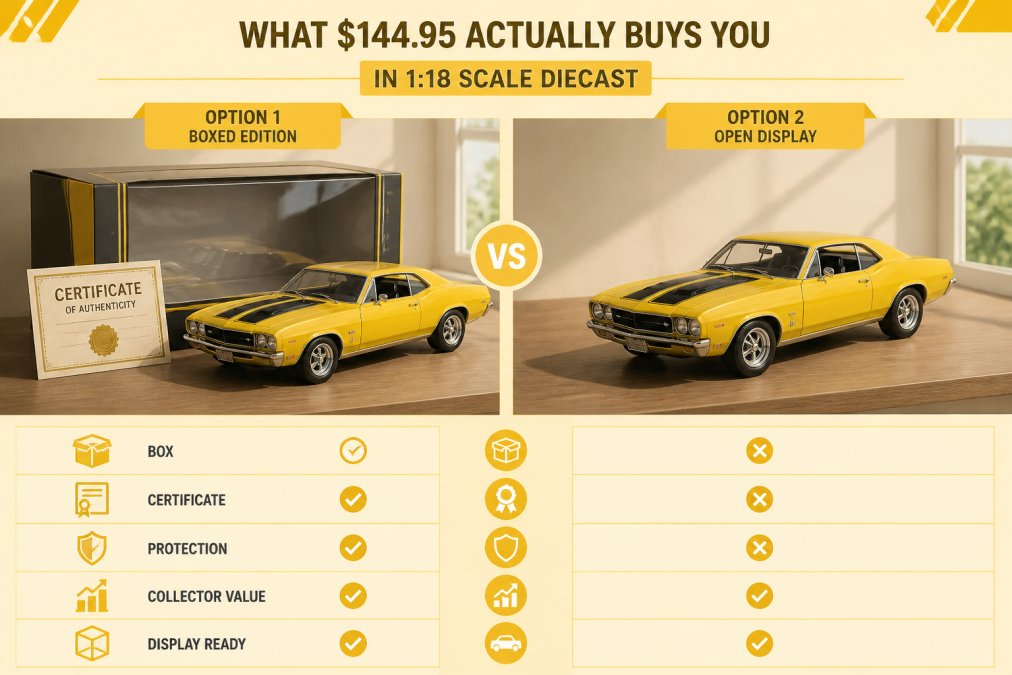
Take our YCID #46, 1970 Cuda in B3 Blue. It is a 440 six-pack coupe with black interior and stripe, a car never previously made in 1:18 scale.

Parts, Tooling, and the COA
The certificate of authenticity is not decoration. It documents the run size and ties your model to a numbered release, which matters when you resell or insure a collection. Our 1969 ZL1 Camaro ships as a Hugger Orange replica with the aluminum-block 427 and body-color dog dish wheels, built on the HWY61 tooling.

Tooling is the other half. A good tool means tight panel gaps, correct stance, and wheels that match the real car's offset. Cheap tooling shows up as crooked bumpers and doors that never quite close.
Limited Edition Diecast Models: Reading Run Sizes Before You Buy
Limited edition diecast models are worth buying when the run size is small, documented, and tied to a car collectors actually want. Run size alone does not create value, but it sets the supply ceiling.
Our 1969 Mustang Mach 1 in Madagascar Orange is limited to 199 units, the first 1969 Mach 1 in that special order color and the first Highway 61-tooled Mustang with the detailed steel wheels. That documented color plus tooling first is what collectors pay attention to.

Why Some Runs Sell Out and Others Sit
Runs sell out when three things line up: a desirable car, a small number, and a detail nobody has offered before. Our 1972 Cuda 340 proves it: coupes run to 199 and convertibles to 48, but the vinyl top version, capped at 60, sold out first.
When a run sits, it is usually because the car is common in the scale, the color is standard, or the run is large enough that nobody feels urgency.
| Version | Run Size | Price | Status |
|---|---|---|---|
| 1970 Cuda 440 Coupe | 199 | $144.95 | Available |
| 1970 Cuda Vinyl Top | 96 | $154.95 | Available |
| 1970 Cuda Convertible | 60 | $194.95 | Available |
| 1972 Cuda 340 Vinyl Top | 60 | $144.95 | Sold out |
| 1972 Cuda 340 Convertible | 48 | $194.95 | Available |
Do Diecast Cars Increase in Value?
Do diecast cars increase in value? Some do, and the pattern is consistent: small documented runs of desirable cars in original condition tend to hold and grow in value, while open-ended mass production rarely does. Nobody can promise a return.
What separates a model that holds value from one that sits is a short list. Run size sets the supply ceiling, desirability of the car and color sets demand, and condition plus completeness of box and paperwork decide whether a buyer pays full freight or haggles.
The Four Levers That Actually Move Resale Value
| Lever | What It Does | What to Look For |
|---|---|---|
| Run size | Caps total supply | Numbered runs under 200 units; under 100 is stronger |
| Car and color | Drives demand | First-time tooling, special-order colors, documented one-offs |
| Condition | Decides the final price | Flawless paint, even panel gaps, intact chrome and trim |
| Completeness | Protects the ceiling | Original box, COA, and any inserts the release shipped with |
Run size is the lever most collectors get wrong. A large run of a popular car can sell out at retail but rarely appreciates, because more examples are always available. A small run of a car collectors already want behaves differently: supply is fixed, and every sale removes one from the pool.
Why Documented Runs Outperform Undocumented Ones
A numbered certificate of authenticity turns a model into a traceable asset. It tells a future buyer how many were made, which release the model belongs to, and whether the box label matches, traceability that lets a resale price hold instead of drifting down to loose-model prices.
Our 1969 Mustang Mach 1 in Madagascar Orange is a working example: limited to 199 units, the first 1969 Mach 1 in that special order color, and the first Highway 61-tooled Mustang with the detailed steel wheels.
The Honest Caveat
Diecast is a hobby first. Buy models you want to look at; if they appreciate, that is a bonus, not a plan. The collectors who do best treat resale value as a side effect of buying well.
Diecast Model Condition: The Single Biggest Value Lever
Diecast model condition decides more of a model's resale value than the car it represents. A rare release with a chipped edge or bent antenna can be worth less than a common model kept flawless. What most guides skip is how to grade condition consistently and document it, which is what actually protects value at resale.
A Simple Four-Tier Condition Scale
Four tiers cover nearly every 1:18 model a collector will encounter. Using the same tiers every time makes it easier to compare two models, price a trade, or describe a model accurately to a buyer.
YCID #46, 1970 Cuda, B3 Blue, 440, Six pack, Coupe, Vinyl Top and Convertbiles →
| Tier | What It Means | Typical Signs |
|---|---|---|
| Mint in box | Never displayed, original packaging intact | Sealed or opened only to inspect; COA present |
| Excellent | Displayed carefully, no visible flaws | No chips, even panel gaps, chrome intact |
| Good | Displayed, minor wear | Small paint touch-ups, faint chrome dulling |
| Display grade | Visible wear or missing parts | Chips, bent antennas, missing mirrors, no box |
Mint in box and excellent models hold the strongest resale position because a buyer can trust the description without an in-person inspection. Display grade models still trade at a discount reflecting the buyer's risk.
What to Inspect, and Why Each Point Matters
- Paint: look for chips at door edges, wheel arches, and the hood line. These are the first places handling shows up.
- Panel gaps: doors, hood, and trunk should sit even and close cleanly. Uneven gaps often signal a drop or a poor tooling run.
- Wheels and tires: check for wobble, cracked rubber, or bent axles. A wobbly wheel is hard to correct and easy to miss in photos.
- Chrome and trim: pitting or flaking is hard to reverse and easy to spot. It is also one of the fastest ways a model drops a tier.
- Box and COA: original packaging and paperwork protect value on resale. A model without its COA loses the traceability that supports a strong price.
Documenting Condition Before You Buy or Sell
Photograph the model from six angles, front, rear, both sides, top, and underside, plus close-ups of any flaw, keeping the COA and box label in frame when you can. A dated photo set is the simplest way to prove condition later, whether insuring a collection or listing a model for sale.
Store models out of direct sunlight and away from humidity. UV fades paint and yellows decals faster than most collectors expect, and both changes are permanent.
Why Condition Beats Rarity in a Side-by-Side Sale
Two identical 199-unit releases, one mint in box and one display grade, will not sell for the same price. The mint example gives the buyer certainty; the display grade example gives the buyer a project. That gap is why condition is the biggest lever a collector controls after purchase, buying well is only half the job.
1:18 vs 1:24 Diecast: Which Scale Holds Up Better Over Time
1:18 vs 1:24 diecast comes down to detail and space: 1:18 wins on detail, 1:24 on footprint.
That detail advantage is also why 1:18 tends to hold value better. Collectors pay for accuracy, and the bigger canvas allows it.
The trade-off is display space.
Our 1970 Dodge Challenger R/T 383 Shaker shows what the larger scale delivers: black finish, white interior, side stripes, Magnum 500 wheels, and a COA, with the coupe at $144.95 and the convertible at $195.95.
Where 1:18 Scale Diecast Falls Short
The honest case against 1:18 is space, cost, and fragility, three limitations, each with a workaround.
- Space: a single model takes real shelf room, so large collections need planning
- Cost: the detail costs more per unit than smaller scales
- Fragility: mirrors, antennas, and opening parts can break if handled carelessly
None are dealbreakers, they are the price of detail. Collectors who display rather than handle their models rarely hit the fragility issue at all.
Who Should Buy, and Who Should Wait
Buy 1:18 scale diecast if you display your collection, value accuracy, and want models that hold their place on a shelf for years.
The collector who gets the most from this scale treats each model as a small piece of automotive history. A documented run, correct tooling, and a certificate of authenticity turn a shelf into something worth showing.
At YCID Diecast and Dioramas, we sell finished, ready-to-display 1:18 scale American muscle cars and display dioramas, with free shipping on in-stock models for orders over $300.00.
The real challenge with 1:18 collecting is not deciding whether the scale is worth it, it is finding documented limited runs that hold their value. Browse our current releases, from the 1970 Cuda 440 to the 1969 ZL1 Camaro, and start your collection with a model built to be looked at.
Frequently Asked Questions
Do 1:18 scale diecast cars actually increase in value?
Some do, most do not. Value tends to climb on models with small production runs, discontinued tooling, and unopened condition. A coupe capped at 199 units has a better shot than a mass-produced model sold everywhere. But there is no guarantee, so treat any 1:18 scale diecast purchase as a collection decision first and a financial one second. Buy the car you want to display.
What makes limited edition diecast models collectible?
Three things drive it: production count, tooling novelty, and documentation. Models advertised as never made before in 1:18 scale, or built from retired tooling, attract collectors because no reissue is coming. A certificate of authenticity matters too. Compare a 199-unit coupe against a 60-unit convertible of the same car, and the smaller run usually commands more attention later.
Does diecast model condition really affect resale value?
It is the biggest single factor after rarity. Paint chips, misaligned doors, scratched glass, and missing parts all cut value, and collectors inspect before they pay. Keep the original box and certificate, avoid direct sunlight on the paint, and handle models by the body rather than the mirrors or spoilers. A flawless example in its original packaging will always outsell an identical model with a chipped hood.
Is 1:18 scale better than 1:24 for collecting?
They serve different purposes. 1:18 scale diecast allows opening panels, detailed interiors, and correct engine bay parts, which is why serious collectors favor it. 1:24 and 1:64 scales cost less and take up far less shelf space, so they suit large displays or tighter budgets. If detail and resale potential matter most, 1:18 is the stronger long-term pick.
How should you assess a 1:18 diecast model before buying?
Check the production count, the tooling history, and whether a certificate is included. Ask whether the model is in stock and ready to ship rather than a preorder. Then review the listing photos for paint finish, panel alignment, and wheel detail. A model that is in stock, documented, and capped at a low number carries less risk than an open-ended release with no stated run size.